Showing posts with label Bolivia. Show all posts

Wednesday, 19 May 2010

Boat over troubled water

Most backpackers are in Copacabana in order to visit Isla del Sol, the birthplace of the Sun itself in Inca mythology. Which may go some way to explaining the extraordinary number of crusties in town.


Wrong

For the last two days, the lake has been too rough for the boats, creating a backlog of eager backpackers (backlogpackers?) trying to get out to the island. I arrive on the one thirty boat fractionally too late to take a prime seat on the roof, so I’m forced onto the main deck, where school chairs are screwed to the floor. It fills with a pungent mix of malignant soap dodgers, crazy Dutch guys, pasty Paddies, some weird Japanese dude and posh English girls roughing it for the first time. Ten minutes before we are due to leave, I realise I can’t deal with it and decide to jump ship. I almost get to the back of the boat before reason takes hold. I stop and sit down. What a tit. Trying to bail on the only chance I will probably ever get to visit such an important Inca site. Chickening out just because I don’t like crusties.

I try and get comfortable in my tiny seat, and not become irritated by the bloke in the stupid hat playing the bongos. Or the jugglers. Or the people in striped trousers. Or the public schoolboys dressed like Robinson Crusoe. But it’s not happening. I make an executive decision. I leave. Immediately. Three hours on that boat for forty minutes walking around part of an island? Seen one you’ve seen them all right? Wight, Man, Dogs, Sun. And I mean, it’s not like the Incas were right anyway, is it?


The Sun. Came out of a small island apparently

An hour or so later I am making my way up Cerro Calvario, past the fourteen Stations of the Cross. In the distance, I can make out the wakes of the tourist boats, and I thank the Lord himself for sparing me. It's hard work getting up there, with the altitude and my back, but I take my time and stop to say hello to the occasional local on his way down. At the top is a row of crosses, and some of the most incredible views I am yet to see. It was so worth it.


Walking up a hill named after the Lord’s last mortal journey, admittedly unladen, but with my back in its current condition, was probably a stupid idea. But in a genuine miracle, it appears to do the trick, and by the time the sun goes down I’m taking my socks on and off just for the fun of it. Not to mention congratulating myself on my unquestionably wise decision to abandon ship and spend the rest of the day enjoying Copacabana, minus a few dozen crusties.

I have a bus to Puno tomorrow lunchtime, but I don’t really want to leave.

Copacabana

Copacabana is a proper little travellers’ town, but I like it. It’s a tiny place whose streets bristle with activity. The locals seem incredibly tolerant of the large backpacker community, and are very friendly if you take the trouble to engage with them. My hotel is halfway up a hillside with a tremendous view of the town.


Copacabana from La Cupula Hotel

An extremely beautiful (and inexplicably Moorish looking) cathedral, the Basilica of Our Lady of Copacabana, takes centre stage. It houses a statue of the Virgin Mary, to which many miracles have been attributed, and is the subject of pilgrimages from all over the world. Also inside is the most spectacular altar I have ever seen. Photographs are banned, but I make a donation and confess my sins.


The spectacular altar...

...and the roof

Confession for the illicit photographer

Outside, Bolivianos make the pilgrimage to bless their automobiles, through a combination of flowers, praying to the Virgin Mary, and letting off firecrackers (again). Stalls even sell toy cars so you can take them inside and bless them.


Outside the Basilica

Aside from its religious notoriety, Copacabana has made a name for its trucha, or trout. We lunch in a local comedor; fried trout, salad and spuds, for 15 Bolivianos. The Cocinera even lets me take her photo.


In the comedor

Cocinera

Later in the evening, four of us dine in a big restaurant in town. I can’t remember it’s name, but then neither can they probably. The waiter doesn’t know how to open a bottle of wine, so we help him out. Then three main courses arrive (excellent grilled trout), but one Trout Lasagna (don’t ask) doesn’t. Upon enquiring of its whereabouts, our grinning friend reassures us “esta en el horno” (it is in the oven). This is only just about topped by the “Irish Coffee” (Milk and whiskey) and the toilets with no light that you have to cross some mud on a plank to reach.

The restaurant at my hostel was pretty good though. Beer battered pejerrey (silverside) may be less popular than the trout but was definitely no less tasty. I also dined repeatedly at a little café called Pueblo Viejo, on the busy street leading down to the lakeside. Its owner is either extraordinarily rude or extremely nice, depending on how many gringos he’s had to tolerate that morning.


Calle 6 de Agosto, Copacabana

Although Copacabana is around 3,800m above sea level, the altitude sickness isn't too much of a problem any more. The sun is though, you need layers of screen on. It gets very warm in the daytime, and bloody cold at night, or in the shade, and as one might imagine, all the town's residents take adequate precautions to deal with the extreme fluctuations in temperature.


It's a dog's life.


Monday, 17 May 2010

Bridge over untroubled water

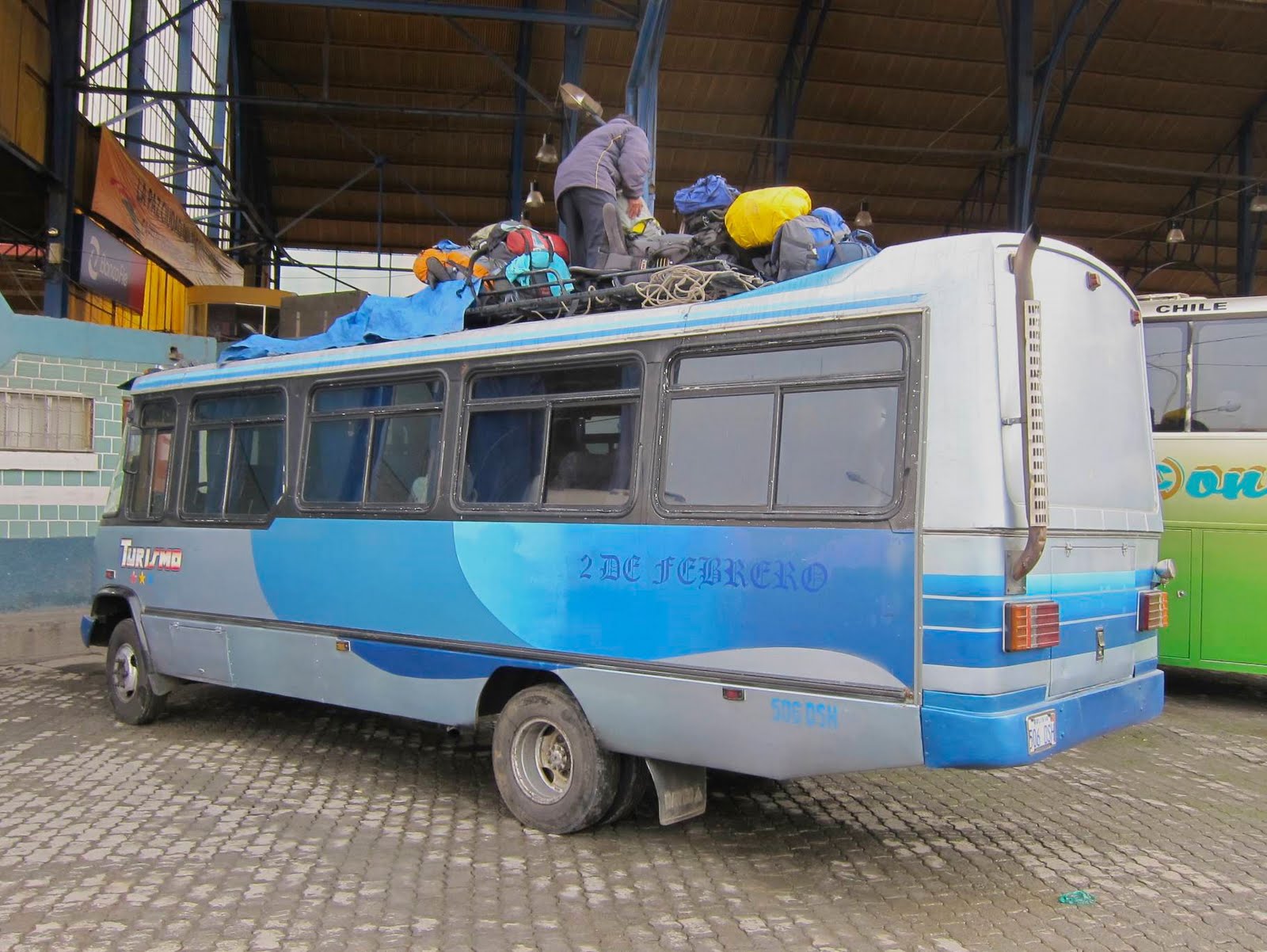
Today’s blog started writing itself long before I woke up. A sensitive appraisal of the increasingly debilitating effect of my back trouble, entitled “Growing Pains”, it would have begun with a tear jerking description of me trying to put my socks on, followed by the fearful prospect of further suffering during a three and a half hour bus journey on Bolivia’s infamously treacherous roads, dowsed first by the prospect of a comfortable reclining seat, then sensationally reignited by this photograph:


It would have documented the pain’s inexorable growth inside me throughout the journey, until I began gnawing through my fingers in agony, pausing only to cry out loud when my rucksack tumbled off the roof, down a hillside, and into the world’s most interesting lake. Then, possibly from a hospital bed, hours, and several hundred irritatingly well-chosen words later, it would have culminated in a slightly over dramatic yet hauntingly resonant and profound treatise on the nature of human suffering.

But it didn’t quite pan out like that. It did start with an unspeakably painful attempt to put my socks on. And that was followed by this photograph;


…taken just before 8am. But I craftily bagged the back row all to myself so I could lie down and alleviate the pain. Until about ten minutes into the journey that is, when we pulled over and the bus filled up with Bolivianos. The rucksack just about stayed where it was, despite a drastic swerve when we may or may not have killed a stray dog.

Two hours in, making sterling progress, and having replaced my deep depression with inexplicable and hopelessly unjustified optimism, we came to an abrupt halt. Unbeknown to me, the journey entails crossing a short stretch of water. On these barges:


There is a long queue of cars, buses and coaches. We wander down to the water’s edge to investigate, but nothing’s happening. We can’t work out why. Eventually, and to our astonishment, we discover the lake is considered too choppy for a crossing. When can we cross? “No se. Mas tarde, tal vez. O mañana.” The prospect sends a shiver down my now twisted spine. We are condemned to wait, helplessly staring at the waves wondering if and when they might relent and allow us to continue our journey. The locals don’t seem too bothered, as usual.


I always understood that in Bolivia, perhaps more than anywhere else in the world, money will buy you anything you want. But no; the coastguards have no price. I am presented with a golden opportunity to test my resolve and not stress or worry about things beyond my control. And this is definitely beyond my control. I mean, if throwing money at it doesn’t work, in Bolivia of all places, then I’m fresh out of ideas. After a few hours lying under the blazing sun, amidst admittedly delightful surroundings, an American guy drawly remarks; “I really appreciate the innate beauty an’ all, but would it have killed them to build a bridge?”


Four hours after we arrived, and a boat attempts the crossing. Successfully, which is cue for the rest of us. Or is it? The coaches nudge optimistically towards the ramps, but the barges aren’t taking the bait. Luckily the smaller boats, that aren’t attempting to float huge buses across a stretch of water (that is now unquestionably a lot choppier than it was this morning) on planks of wood, have started ferrying passengers across. We abandon ship, get our gear from the roof rack and join the rush.


Despite being an incurable chicken when faced with the merest sniff of danger, and my hopelessness at swimming notwithstanding, I’m actually okay on the water. But they were right. It is choppy. Our tiny craft is thrown about for ten hilarious minutes, a few people looking pretty scared and tenaciously gripping the sides. But if we were in our bus on one of those things, I would be shitting myself with fear.


Eventually on the other side, we cram into a local minibus and begin the final leg of our journey to Copacabana. The scenery is extraordinary, but we’ve earned it. Laden with bags, I walk a few blocks to my hostel and find my room still available. I take a hot shower, power nap, and drink a cold beer looking down over Copacabana as the disappearing sun bathes it in golden light. A couple of guys are playing cards on the table next to me. They stop and we chat. After a while, the Kiwi asks, “You know how to play shithead mate?” And in the joyous hours that followed, I almost forgot that I could no longer move my body.

Sunday, 16 May 2010

Street food for thought

Sometimes you eat the street food, and sometimes, well, it eats you. I spent yesterday morning walking, climbing and taking pictures, then indulged in a little empanada tucamana from a lady near the bus station. It tasted good, but later on, it had its revenge. Combined with the unrelenting headache it brought my day to an early end.

I watch a movie, go through my pictures, try and keep myself distracted. By the time I'm ready for bed, things are worse. It's cold. My whole body is now aching. I manage to fall asleep. For twenty minutes. This pattern continues all night. At one point I think I managed a whole hour in one go.

I'm pretty bad when I get ill. I sulk, get depressed. At home, this is just about bearable. Alone, on the other side of the world, oh dear. Things aren't helped by the fact that I've just finished reading The Sheltering Sky by Paul Bowles, in which one of the main protagonists dies of typhoid whilst travelling around Morocco. I google typhoid. Stomach's on the mend. Don't think it's that. It's the altitude. And I won't be getting any lower for a good while yet. Which means I need to man up and deal with it.

I let the ibuprofen and acetazolamide work their magic and head out. Walking down the street, I am alarmed to discover that I am in crippling agony with my dodgy back. I stop for lunch. About thirty seconds after I leave, it starts raining. Oh wait, that's not rain. It starts hailing. Hard. I can't walk anyway, it hurts too much. But not as much as having to spend another afternoon inside my hotel when a city as cool as this one is outside the door.


La Paz shoeshine boys all wear ski masks. Don't ask me why

Mujeres de La Paz

Shade

Sagarnaca from the roof of Iglesia San Francisco

Looking up towards El Alto from San Francisco

They're at it again

Colectivo

Jugo de naranja, La Paz style

Terminal de buses, designed by Gustav Eiffel

Street food

Friday, 14 May 2010

Marching Powder

I hadn't expected to be woken by the sound of gunfire this morning. But I was. It was accompanied by a lot of shouting, chanting and police sirens, and in Bolivia, that can only mean one thing. (I should probably stress that it was the sound of gunfire, and not actual gunfire...)

Demonstrations are a part of everyday life here. I'm keen to get out there and see what's going on but, ever the intrepid traveller, I need my breakfast first. By the time I've broken my fast (great granola and queso creollo) then taken a long shower, the excitement seems to have dissipated. I take to the streets myself, instead, in silent protest.

I'll admit to being a little bit nervous about coming to La Paz. It's very different to the westernised cities I've been frequenting so far, and I was worried about being out of my comfort zone. I needn't have been. Sure, it's completely different; a whole world apart. But I love it.


The pavements bristle with activity. Women in bowler hats man little stalls or blankets laid out with goods. Food is on sale everywhere; soup, empanadas, bread, vegetables. Barrows are full of oranges and grapefruits, all peeled and ready to be squeezed. In amongst them, the men ferry impossible loads up and down the steep slopes. Taxis, buses and minibuses cram the roads, they hoot and shout their destinations from the windows. The place is so real and alive. Colour, energy and excitement pour forth; it adds up to an incredible assault on the senses. But somehow, despite all this, I can detect a very deep sense of calm. It's all just a part of life here.


The Prado

Lunch break

I walked about, intoxicated by it all, but also feeling the pinch of the soroche (altitude sickness). I got some pills to ease me along, and wandered aimlessly. You can't get lost in this town - wherever you are, head downhill and you'll hit El Prado, the main street. It reminds me so much of Morocco. The busy twisting roads, the bustle, the shops and the shopkeepers; everything overflowing onto the street. A guy handing out flyers walks past. I catch a glimpse of a word on the paper and run back after him. It's for a restaurant called Marrakech.

I wander for a while, and grab some food in a little bakery. (Later I will buy the best bread I have eaten all year off a girl on the street for less than five pence). Eventually the headache pounds me into submission and I retreat to the hotel for a siesta. I'm soon out again though. This time I head away from the main streets, and let my eyes lead me. Via a great street market (with no gringos) I drop down into Plaza San Pedro, home of the famous prison that was once a tourist attraction*, before climbing up the other side of the valley.

The soroche pills are working their magic and my fingers are tingling, pumped full of blood. Fortunately my other extremities seem normal enough, because at the top of the hill is a little kids playground from which you can see the whole city. I descend, only to have to climb once more, and walk the east side of the Prado. Which is when I hear, and see, the demonstrators again.


This time I investigate. It's hilarious. There are police everywhere and thousands of people are marching. A few bonfires have been lit and flares and firecrackers are going off all over the place. What to me is the cause of great excitement is just another minor event in the course of their day. People wander in and out of the police cordons on their way home from work, and when I get stuck the other side of one, I just wander alongside the marchers until I can drop away again. Now I'm one of them, maybe they'll wait until I've finished my breakfast tomorrow.


*There is a book, entitled Marching Powder, written in the first person, by an Australian, about an Englishman incarcerated in San Pedro Prison for smuggling cocaine. Don't read it. It is incredibly badly written. I only kept reading it in the hope something bad would happen to either of them. It didn't.


**I can't believe I have started writing footnotes on my blog. Does anyone know how you do those little numbers in the corner?

Thursday, 13 May 2010

One day, many changes

Just after 4 o’clock this morning, when I emerged wearily from the door of my hotel, there was a distinct chill in the still air of Santiago, not to mention thick fog. I watched my two bags be stowed in the trunk of a taxi, before following them into the warmth and beginning, what felt like at least, an important part of my journey.

By 6 o’clock, a diminutive aeroplane was powering off into the invisible night. I watched as the city of Santiago, mapped out by flickering orange lights, emerged from the darkness below then promptly disappeared again beneath a blanket of thick cloud. At night, there is little to be seen of nature, save for the stars.

Shortly after that, to my right, the first embers of the day began to glow, and night slipped quietly away on my left. Nowhere else on Earth are we quite so reminded of our daily rotation. Below, the clouds dispersed to reveal the Pacific Ocean lapping at the fringe of the empty Atacama Desert, the driest place on Earth.

Having divested ourselves of most of our passengers at Iquique, we took off once more and headed inland. The arid desert is broken at times by old riverbeds that seem to retain enough moisture to allow themselves to be cultivated - little patches of coloured fields wind their way into the barren landscape.


Without ever really seeming to make a descent, we landed at La Paz. We had taken off from Iquique, on the coast, and climbed to cruise at around 10,000 metres. La Paz airport, in El Alto, is the highest in the world at over four kilometres above sea level. The ground reaches up to claim us so much as we descend toward it.

This can cause a few problems. The best way to deal with altitude sickness is to climb gradually and acclimatise. I drop in out of the sky, and it is tough going at the airport. Luckily, downtown is a good 400 metres lower, which helps. As we drive towards it, I get my first glimpse of the city. It is clinging unfeasibly to the sides of an enormous canyon, under icy peaks, and it looks incredible.


I take my time walking about town getting a feel for the place but not wanting to over exert. I've known all along that today would mark a change; a new phase in my adventure. That the journey should be filled with so many contrasts to emphasise this was an unexpected bonus. The last thing I want to do is get ahead of myself, so I follow the local advice; camina lentito, como poquito y duerme solito (walk slowly, eat little, sleep alone). The rest can wait until tomorrow, and a more civilised hour.