I left Laos last Thursday, in perfect Laotian style, on a propellor plane that took off half an hour early when it became apparent that all passengers were present and correct. I could easily have stayed a lot longer; no doubt now that it is my favourite country in this part of, if not all, the world.
When I look back on the last month, I might find it hard to fish out memories of the two weeks I spent in Vietnam. Instead I will think of the country I first glimpsed from the bank of the Mekong in Chiang Khong, Thailand, wondering if it could really be so different. It began then, with a moonrise, and ended with a sunset. In between just seemed like one long, glorious day.
Since then, I have been in Siem Reap, Cambodia. There's only one reason it's on the map; Angkor Wat. Over two million punters pour through this little town every year, and it struggles to retain its spirit in the face of the onslaught. Time is short now, and sadly I will only see here and Phnom Penh in Cambodia, which is a bit like not really seeing Cambodia at all.
I've been feeling a little disjointed these past few days. It could be Laos withdrawal, it could be the intense tourist overload, the heat, temple fatigue. Or it could be that another part of the trip is drawing to a close, another continent looming. Or more than that, it could be the fact that in the distance, so small I can hardly see it, but big enough for me to know it's there, I think I can make out a tiny speck of tunnel at the end of the light.
Showing posts with label Laos. Show all posts
Showing posts with label Laos. Show all posts
Monday, 29 November 2010


Thursday, 25 November 2010
Coffee

Shortly after half past seven in the morning, freshly showered and my fast inadequately broken by a plate of fruit, a stale baguette and a cup of crap coffee, I squeezed into a well worn crash helmet, fired up my brilliantly named Suzuki Smash 110 and slipped conspicuously into the stream of early morning traffic snaking its way around the busy streets of Pakse.
Riding into the rising sun, and the rising ground of the Bolaven Plateau that sits 1,300 metres above sea level, one by one my co-riders disappeared from the highway and I found myself again in glorious isolation. An hour or so and fifty kilometres later (either the speedo or the milestones were lying, since I never dropped below sixty), in the remote town (read village) of Paksong, I finally pulled up and prised my numb buttcheeks from the saddle. There was a sign by the side of the road. It said Coffee.
The French introduced coffee to the Bolaven Plateau in the nineteenth century. After a brief lull when the Americans bombed the crap out of the place in the 60s and 70s, production is booming again, and almost everyone in Paksong is involved in the business to some extent. Coffee trees grow by the side of the main road, and in plantations that back onto people's simple houses.
A Dutchman, whose passport says Cornelius but has been called "Coffee" since he was a toddler, lives here with his Laotian wife, herself from a long line of coffee growers, and runs tours and workshops for the bean loving tourist, as well as offering a cup of his finest to anyone passing through.
In the morning we wander around, look at coffee trees and learn from Coffee the whole process of cultivation, harvest and production. Out the back of his house family members pour berries into an old tomato skinning machine, and wade around in the resulting beans, before they are laid out to dry. There are different ways of doing this - some are cleaned in water, some are not, absorbing more flavour as a result.

Freshly picked coffee berries

Beans from the berries

Drying in the sun
Coffee hand picks the best beans and hand roasts them in an old wok. Since the green beans come from different plantations, have been processed differently, and roasted in individual batches, there is no consistency to the result. Actually that's not true - the only consistency is that the coffee is of an exceptionally high standard, and the differences are the real beauty of this method.

Green beans in the wok
He teaches me to wok roast. As well as the basic technique for keeping them moving around, it's a question of understanding the different stages and recognising how the colours, aromas and sounds change. Somewhere between a light and medium roast, the now browned, fragrant beans are stylishly cooled. They're best a week or so after roasting, but I haven't got that long, so we grind a few and I sip the satisfying fruits of my labour.

Cool your beans
This is coffee with character, like fine wine. Every single cup produced in this way is an expression of something else; the beans; where they're from, how many there are. The weather; how the wind blows over the wok, how much moisture in the air, how hot it is. The roaster; what mood they're in, how they stir and for how long. How quickly they're cooled, how they're ground. If you want the same taste every time you drink a cup of coffee, try Nescafe Gold Blend. It's nothing if not consistent.
Wednesday, 24 November 2010
Small World
Well that didn't take long. I rocked up at Savannakhet bus station just before 8am to discover the 8am is actually at 9am. Oh well, je ne regrette rien. I ended up sat next to an incredibly beautiful Laotian girl for my troubles, one of a group of trainee midwives heading to Pakse for some exams. Their teacher was sitting in front of me and immediately set about trying to marry us off to one another, which made for an entertaining five and a half hour journey.
As if that wasn't enough, every time we stopped (and we stopped many times) we were boarded by marauding women and children waving bottles of water, barbecued chicken, boiled eggs, bags of sticky rice and beef jerky. Hilarious scenes ensued as they clambered over the plastic stools in the aisle whenever we took off with them still on board. The toilet stops were no less amusing, men and women filing neatly into the bushes to splash their boots.
After wandering around Pakse, busier than other towns along the way but with Laotian charm surviving intact, I took myself down to the confluence of the Mekong and the Se Don to watch the sunset. Another English guy turned up a few minutes later, and we drank our Beerlaos together. It took about ten seconds to establish that we had been to the same Sixth Form, at the same time, and though we didn't exactly know each other, we shared plenty of friends in common and had both been at one of them's wedding last year. It had to happen sooner or later in a world this big.

As if that wasn't enough, every time we stopped (and we stopped many times) we were boarded by marauding women and children waving bottles of water, barbecued chicken, boiled eggs, bags of sticky rice and beef jerky. Hilarious scenes ensued as they clambered over the plastic stools in the aisle whenever we took off with them still on board. The toilet stops were no less amusing, men and women filing neatly into the bushes to splash their boots.
After wandering around Pakse, busier than other towns along the way but with Laotian charm surviving intact, I took myself down to the confluence of the Mekong and the Se Don to watch the sunset. Another English guy turned up a few minutes later, and we drank our Beerlaos together. It took about ten seconds to establish that we had been to the same Sixth Form, at the same time, and though we didn't exactly know each other, we shared plenty of friends in common and had both been at one of them's wedding last year. It had to happen sooner or later in a world this big.

Tuesday, 23 November 2010
Eco-tourism
Eco-tourism is the new big thing in Southern Laos. Having donated my English skills to the local Eco Guide Unit, I thought I should probably take on one of their treks as well and get a look at the nearby Dong Natad Protected Area.
The obligatory tuk-tuk carried my shaken remains out of town for a good forty minutes to our first stop, a salt factory. They pump 55% saline water out of the ground and either leave it to dry in the sun, or boil it in big wood burning trays. All of which makes for some nice photographs, but I'm struggling to find the environmental angle.


The trek through the forest is interesting, but I find myself in a strange mood, and am really struggling to engage. We walk, occasionally talk, and they point out things you can eat, enormous termite mounds, and trees that the locals draw oil from for their lanterns. Again, I don't really see how burning holes in trees in order to get fuel is an environmentally sustainable practice, but maybe I'm missing something.

The forest is beautiful, but it's less daunting and alien than the one I trekked in Thailand. Hallowe'en style cobwebs adorn every tiny branch, and an assortment of strange insects threaten me at every turn.


These ants smell of vinegar if you crush them in your hands (not very Buddhist?), earning the nickname sour ants, and their eggs are a delicacy apparently, though I don't get to try. The morning redeems itself by arriving at a splendid lake, where we stop for lunch and I put my guide in his place in a stone skimming contest (growing up in Worthing has its advantages).

I'll have to confess to being slightly underwhelmed by the whole experience, but these are early days, for the whole idea of taking tourists into this area, and for the guides and villagers who facilitate it.
What I discovered was the role eco-tourism has in educating local people about the importance of preserving their natural environment. Most things boil down to economics, and if you live in a forest and can make more money chopping it down than leaving it where it is, then that is probably what you're going to do. Tourism offers an alternative though. The local Eco Guide Unit goes into the villages and explains how to gather NTFP (Non-Timber Forest Products), puts up signs and rubbish bins and educates the locals in how to use them. It will take time, a lot of time.
But the ball is rolling at least, and in a few years things should be a lot better. In the meantime, if you're passing through, your patronage will help them get off the ground, and maybe even pay for a few lightbulbs so they can stop bleeding the trees dry...
The obligatory tuk-tuk carried my shaken remains out of town for a good forty minutes to our first stop, a salt factory. They pump 55% saline water out of the ground and either leave it to dry in the sun, or boil it in big wood burning trays. All of which makes for some nice photographs, but I'm struggling to find the environmental angle.


The trek through the forest is interesting, but I find myself in a strange mood, and am really struggling to engage. We walk, occasionally talk, and they point out things you can eat, enormous termite mounds, and trees that the locals draw oil from for their lanterns. Again, I don't really see how burning holes in trees in order to get fuel is an environmentally sustainable practice, but maybe I'm missing something.

The forest is beautiful, but it's less daunting and alien than the one I trekked in Thailand. Hallowe'en style cobwebs adorn every tiny branch, and an assortment of strange insects threaten me at every turn.


These ants smell of vinegar if you crush them in your hands (not very Buddhist?), earning the nickname sour ants, and their eggs are a delicacy apparently, though I don't get to try. The morning redeems itself by arriving at a splendid lake, where we stop for lunch and I put my guide in his place in a stone skimming contest (growing up in Worthing has its advantages).

I'll have to confess to being slightly underwhelmed by the whole experience, but these are early days, for the whole idea of taking tourists into this area, and for the guides and villagers who facilitate it.
What I discovered was the role eco-tourism has in educating local people about the importance of preserving their natural environment. Most things boil down to economics, and if you live in a forest and can make more money chopping it down than leaving it where it is, then that is probably what you're going to do. Tourism offers an alternative though. The local Eco Guide Unit goes into the villages and explains how to gather NTFP (Non-Timber Forest Products), puts up signs and rubbish bins and educates the locals in how to use them. It will take time, a lot of time.
But the ball is rolling at least, and in a few years things should be a lot better. In the meantime, if you're passing through, your patronage will help them get off the ground, and maybe even pay for a few lightbulbs so they can stop bleeding the trees dry...
Savannakhet
You may have gathered by now that I'm growing rather fond of Laos. You are also probably sick of hearing me gushing on about its cheerful, languid population, decaying architectural glory and overwhelming air of gentle serenity. But we haven't been to Savannakhet yet.


My first interaction with the locals came when two kids quietly approached me as I took a picture of the Catholic church (the only building in town not in a state of utter disrepair), and started looking at my camera. I pointed it, shot, and showed them the picture on the back. The result was a sort of shuddering laugh of total disbelief, shrinking nervously away from me, as if I had just performed some twisted kind of black magic.

When I walked back a couple of hours later they were still pushing each other round in circles on their tricycle, and had apparently recovered from the shock.

Shops and homes spill out onto the streets, where kids play as grandparents sit and watch and mums and dads quietly tinker about. Again, there is that wonderfully calming sense of a place just ticking along, doing what it needs to get by, and never anything more. Of course, there is absolutely bugger all to do here except watch these warm, hypnotic scenes playing themselves out before you, but who cares?
I looked over the balcony just after sunset, and saw a kid of maybe four or five strolling down the street, past a stray dog licking itself and someone sweeping the front of their shop, all of them with an extraordinary economy of movement. High above the rooftops that teeter on the edges of crumbling walls, a makeshift kite danced its way across the full moon, watched by invisible but audible children, shrieking in the nearby square, as I reclined, took another sip of Beerlao and sighed contentedly.


My first interaction with the locals came when two kids quietly approached me as I took a picture of the Catholic church (the only building in town not in a state of utter disrepair), and started looking at my camera. I pointed it, shot, and showed them the picture on the back. The result was a sort of shuddering laugh of total disbelief, shrinking nervously away from me, as if I had just performed some twisted kind of black magic.

When I walked back a couple of hours later they were still pushing each other round in circles on their tricycle, and had apparently recovered from the shock.

Shops and homes spill out onto the streets, where kids play as grandparents sit and watch and mums and dads quietly tinker about. Again, there is that wonderfully calming sense of a place just ticking along, doing what it needs to get by, and never anything more. Of course, there is absolutely bugger all to do here except watch these warm, hypnotic scenes playing themselves out before you, but who cares?
I looked over the balcony just after sunset, and saw a kid of maybe four or five strolling down the street, past a stray dog licking itself and someone sweeping the front of their shop, all of them with an extraordinary economy of movement. High above the rooftops that teeter on the edges of crumbling walls, a makeshift kite danced its way across the full moon, watched by invisible but audible children, shrieking in the nearby square, as I reclined, took another sip of Beerlao and sighed contentedly.
Monday, 22 November 2010
Language barrier
Hmmm, let's see now: shall I get the express bus at 8.30 in the morning, or the local bus at 10.30? Shortly after 7.30 I was regretting my decision, as I was rudely awoken by everyone less lazy than me clattering down the stairs with their suitcases and shouting unnecessarily at one another.
The boot was on the other foot at 10.15 though when, replenished by the extra sleep after their hostile interruption, I arrived at Tha Khaek bus station to find them all slumped miserably on uncomfortable wooden benches where they had spent the last two hours or so since the express bus had been cancelled. I try not to be smug for too long, since doing so has a habit of returning to kick me in the ass, but I'll indulge myself on this one: Ha-ha. Suckers.
I've just finished reading a brilliant book called Iron and Silk by an American named Mark Salzman. It's a wonderful collection of observations and recollections from his time in China in the early 80s, none of which would have been possible had he not actually spoken the language. Swapping seats during the ride to Savannakhet when I lost the feeling in both my legs, I found myself next to a Laotian guy who spoke a bit of English and was keen to chat. "I teach you Lao", he unwittingly offered, as I reluctantly unplucked the headphones.
Within a couple of hours he had managed to teach me how to say "Good Luck" and "Help!" in addition to "Hello" and "Thank you very much" which I already proudly boasted among my armoury. But I now have some interesting phonetic pronunciation notes scrawled across the back of my Lonely Planet, and a printed e-ticket decorated with various scribblings, including an enormous "I love you" in Lao that could make check-in interesting.
As soon as I got to my guest house in Savannakhet I took a stroll around town, and within five minutes I'd been accosted by a guy from the local Eco-Tourism unit. He was trying to respond to a series of lengthy questions from a Dutch company that is providing funding for them, and was struggling with the English. An hour or so later, and I can't help thinking that the recipient of his lyrical reply might not wonder if he'd had a bit of passing help, but somehow it seemed the right thing to do.
All of which led me to reflect that speaking a native language does far more than make life easier for you. It creates the opportunity to engage with locals and gain their trust, respect and understanding. It gives you the confidence to approach people and make allowances for the offence you dread causing them. It makes every second of the time you invest there rewarding and enriching.
I think back to conversations with taxi drivers and strangers in South America, where my fledgling Spanish was pathetic, but still enough, and dearly wish I could speak Lao.
The boot was on the other foot at 10.15 though when, replenished by the extra sleep after their hostile interruption, I arrived at Tha Khaek bus station to find them all slumped miserably on uncomfortable wooden benches where they had spent the last two hours or so since the express bus had been cancelled. I try not to be smug for too long, since doing so has a habit of returning to kick me in the ass, but I'll indulge myself on this one: Ha-ha. Suckers.
I've just finished reading a brilliant book called Iron and Silk by an American named Mark Salzman. It's a wonderful collection of observations and recollections from his time in China in the early 80s, none of which would have been possible had he not actually spoken the language. Swapping seats during the ride to Savannakhet when I lost the feeling in both my legs, I found myself next to a Laotian guy who spoke a bit of English and was keen to chat. "I teach you Lao", he unwittingly offered, as I reluctantly unplucked the headphones.
Within a couple of hours he had managed to teach me how to say "Good Luck" and "Help!" in addition to "Hello" and "Thank you very much" which I already proudly boasted among my armoury. But I now have some interesting phonetic pronunciation notes scrawled across the back of my Lonely Planet, and a printed e-ticket decorated with various scribblings, including an enormous "I love you" in Lao that could make check-in interesting.
As soon as I got to my guest house in Savannakhet I took a stroll around town, and within five minutes I'd been accosted by a guy from the local Eco-Tourism unit. He was trying to respond to a series of lengthy questions from a Dutch company that is providing funding for them, and was struggling with the English. An hour or so later, and I can't help thinking that the recipient of his lyrical reply might not wonder if he'd had a bit of passing help, but somehow it seemed the right thing to do.
All of which led me to reflect that speaking a native language does far more than make life easier for you. It creates the opportunity to engage with locals and gain their trust, respect and understanding. It gives you the confidence to approach people and make allowances for the offence you dread causing them. It makes every second of the time you invest there rewarding and enriching.
I think back to conversations with taxi drivers and strangers in South America, where my fledgling Spanish was pathetic, but still enough, and dearly wish I could speak Lao.
Sunday, 21 November 2010
Full Throttle
The bus ride from Vientiane to Tha Khaek was a surprisingly comfortable and uneventful way to pass five and a half hours. Especially compared to the minutes preceding them, when the driver of our sawng thaew (half tuk-tuk, half pick up truck), realising his passengers had missed the bus, decided to pursue it instead, eventually catching up with it about twenty rickety minutes into its journey and flagging it down on the main road.
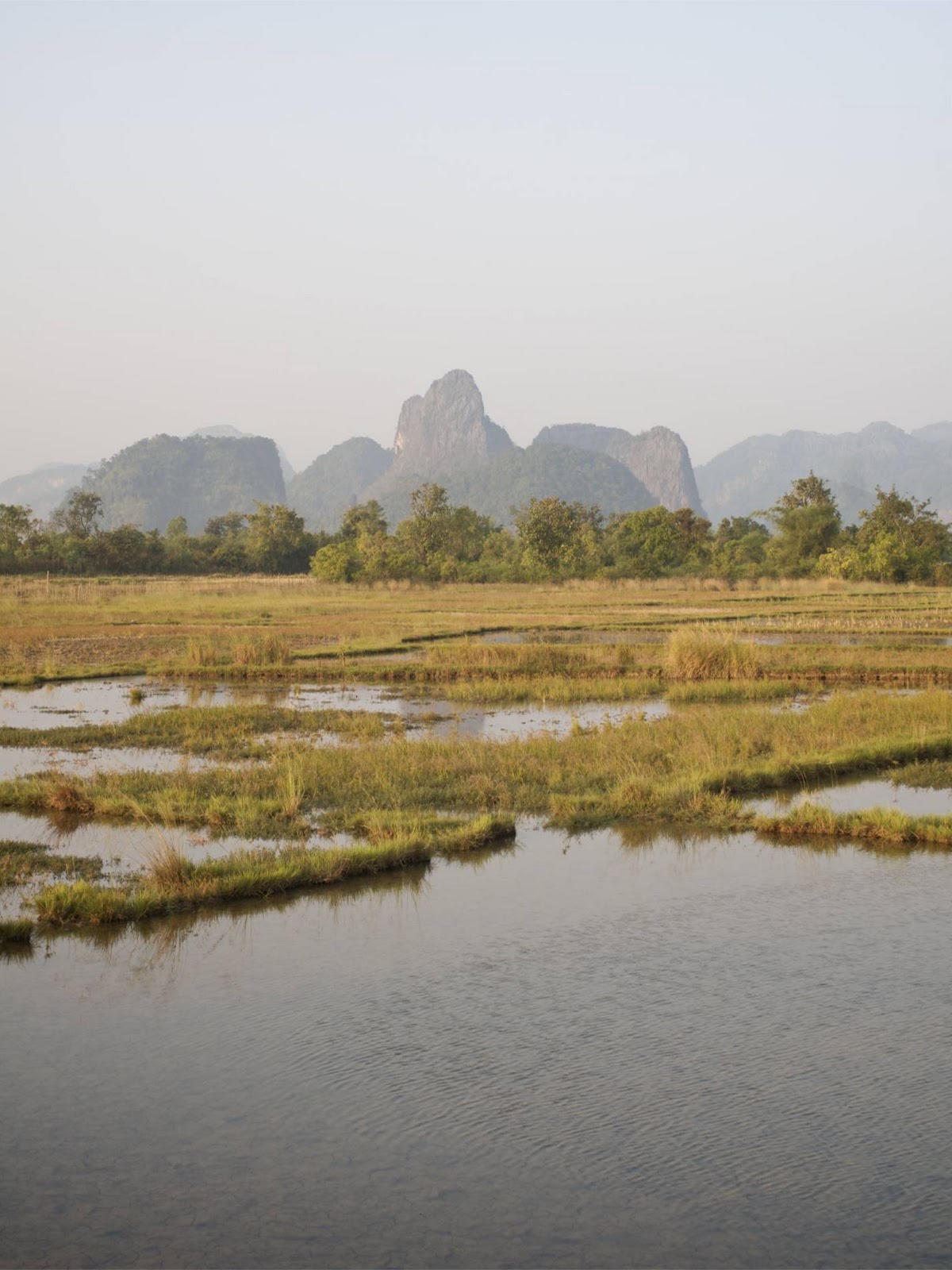
Not a lot really goes on in Tha Khaek. It sits on the Mekong, entertaining travellers using the nearby border, or stopping on their way north and south, like me. No-one really stays here for too long, but plenty use it as a base for touring inland. Renting a motorbike entails a long walk, and I get the last one, which has definitely seen better days. I rattle my way east, through fields punctuated by limestone karsts and pools of emerald green water; a kind of Halong Bay on land, but I have it all to myself.

The towering rock formations shelter a number of impressive caves. I pull over at one and am immediately accosted by three kids, who offer to be my guide. On our way through the thin jungle, they pull long serrated leaves from plants, and sword fight with them. Sensing my disappointment at being left out, they procure one for me, which then entitles them to attack me whenever they wish. At the cave, I'm taking pictures, and when I turn round they've picked up my guide book and are looking at the pictures. They point at every white guy in there and ask if it is me.

Pretty much everyone I pass on the bike waves and yells sa-bai-dii. Kids especially; often I can't actually see them, they're rolling in mud or up a tree or something, but I hear them and shout back as I trundle on by. The scenery, the pure colours that surround me and the unbridled joy of shouting and waving at people leave me completely elated. It's a sense heightened by my solitude, and that wonderful feeling you get of being on an open road and completely in control of your own destiny.

Then the throttle cable snaps. It could be worse; I passed some houses half a mile back, so push my untrustworthy steed through the dust. Luckily enough, one of them is a shop, specialising, amongst other things (most other things), in motorcycle repair. The guy comes out, followed tentatively, one at a time, by his kids, each of whom stares at me then runs away laughing. As he dismantles the front of the bike, I watch a chicken pecking his way through the house and pissing all over the floor. Unbelievably, he cheerfully produces a replacement cable, which he supplies and fits for the princely sum of 20,000 kip (£1.60 or $2.50). I buy him a Beerlao as well and carry on where I left off.
By now the sun has dropped a little further, and the light is incredible. I ride the eight kilometres or so back to the main road pretty slowly, soaking up the golden light and thinking how great life is when you strip it back to its purest form. I get a few lungfuls of dust for my trouble, but in all honesty, they only make me more certain.


Not a lot really goes on in Tha Khaek. It sits on the Mekong, entertaining travellers using the nearby border, or stopping on their way north and south, like me. No-one really stays here for too long, but plenty use it as a base for touring inland. Renting a motorbike entails a long walk, and I get the last one, which has definitely seen better days. I rattle my way east, through fields punctuated by limestone karsts and pools of emerald green water; a kind of Halong Bay on land, but I have it all to myself.

The towering rock formations shelter a number of impressive caves. I pull over at one and am immediately accosted by three kids, who offer to be my guide. On our way through the thin jungle, they pull long serrated leaves from plants, and sword fight with them. Sensing my disappointment at being left out, they procure one for me, which then entitles them to attack me whenever they wish. At the cave, I'm taking pictures, and when I turn round they've picked up my guide book and are looking at the pictures. They point at every white guy in there and ask if it is me.

Pretty much everyone I pass on the bike waves and yells sa-bai-dii. Kids especially; often I can't actually see them, they're rolling in mud or up a tree or something, but I hear them and shout back as I trundle on by. The scenery, the pure colours that surround me and the unbridled joy of shouting and waving at people leave me completely elated. It's a sense heightened by my solitude, and that wonderful feeling you get of being on an open road and completely in control of your own destiny.

Then the throttle cable snaps. It could be worse; I passed some houses half a mile back, so push my untrustworthy steed through the dust. Luckily enough, one of them is a shop, specialising, amongst other things (most other things), in motorcycle repair. The guy comes out, followed tentatively, one at a time, by his kids, each of whom stares at me then runs away laughing. As he dismantles the front of the bike, I watch a chicken pecking his way through the house and pissing all over the floor. Unbelievably, he cheerfully produces a replacement cable, which he supplies and fits for the princely sum of 20,000 kip (£1.60 or $2.50). I buy him a Beerlao as well and carry on where I left off.
By now the sun has dropped a little further, and the light is incredible. I ride the eight kilometres or so back to the main road pretty slowly, soaking up the golden light and thinking how great life is when you strip it back to its purest form. I get a few lungfuls of dust for my trouble, but in all honesty, they only make me more certain.

Saturday, 20 November 2010
Vientiane
It wasn't quite so much a "secret hint" that finally led me to Vientiane, more of a persistent niggle. Only my lackadaisical planning kept me away on my first trip to Laos, and there was a kind of symmetry to the fact that some Laotian nonchalance should combine with it to shorten my time in Vietnam and bring me back.
At no point does Vientiane ever feel like a city. It's busier than Luang Prabang, and exhibits a few more trappings of modernity, but compared to say Hanoi, it is a mere sleepy village. The bars, restaurants and guesthouses cluster around the centre of town. In between them, sumptuous golden temples sit snugly, and bouganvillea hauls itself lazily over over the walls.

Old colonial buildings and villas line the streets, in varying stages of decay. The Lao National Museum resides in one such place, black streaks and the stains of time obscuring it's once white walls. Inside, a series of interesting but dusty exhibits share space with a pretty impressive range of semi-automatic weapons, and photographs with captions like Comrade So-and-so single handedly captures American Imperialists. Apart from one old lady on the front desk, there don't appear to be any other people here, until towards the end I hear excited voices and the now familiar clinking of petanques, as the entire staff play boules and drink Beerlao in the shady courtyard out back. Behind it, the National Stadium has a kind of Escape to Victory feel to it.

There's enough traffic to kick up a few fumes. Jacked up tuk-tuks where you sit on a bench at a 30º angle and try not to slide out the back, a few mopeds, and vintage VW Beetles. I would say there is a "heavy" police and military presence, but that would imply some level of intimidation or a sense of lurking oppression. There are a lot of them, and they do have guns slung across their backs, but half of them are asleep and the other half are directing traffic at every intersection, in complete contradiction to the perfectly functioning traffic lights.

From the Presidential Palace a wide Parisian boulevard stretches north to Patuxay, a sort of poor man's Arc de Triomphe, made entirely out of cement that was meant for a new runway. It has a kind of cracked charm to it, interrupted only by the few floors of market stalls hidden inside it's upper levels.

The French influence doesn't stop with wide streets and pointless arches. Everywhere you go you can smell freshly baked baguettes and croissants. The coffee here is as good as I have drunk for months. The women are beautiful and elegant. Nearly all of them wear Lao skirts, or sinhs, of long, narrow, delicately patterned silk. According to the Vientiane Times, the styles

The clues are there I suppose; Presidential Palace, wide avenues, triumphant arch, symbolic temples, superfluous security. It might not feel like a city, but it is the Capital. The white guys in suits, too; embassy staff and NGO workers, I guess. They mingle effortlessly with the orange robed monks and flip-flopped backpackers in the tapestry of Vientiane's streets. This is whole heartedly a place in which to sit quietly, drink coffee or beer and watch the world as it trickles past at its own sedate pace, pausing occasionally perhaps, to join you for a few moments over a pastis, before sliding gently on by.
At no point does Vientiane ever feel like a city. It's busier than Luang Prabang, and exhibits a few more trappings of modernity, but compared to say Hanoi, it is a mere sleepy village. The bars, restaurants and guesthouses cluster around the centre of town. In between them, sumptuous golden temples sit snugly, and bouganvillea hauls itself lazily over over the walls.

Old colonial buildings and villas line the streets, in varying stages of decay. The Lao National Museum resides in one such place, black streaks and the stains of time obscuring it's once white walls. Inside, a series of interesting but dusty exhibits share space with a pretty impressive range of semi-automatic weapons, and photographs with captions like Comrade So-and-so single handedly captures American Imperialists. Apart from one old lady on the front desk, there don't appear to be any other people here, until towards the end I hear excited voices and the now familiar clinking of petanques, as the entire staff play boules and drink Beerlao in the shady courtyard out back. Behind it, the National Stadium has a kind of Escape to Victory feel to it.

There's enough traffic to kick up a few fumes. Jacked up tuk-tuks where you sit on a bench at a 30º angle and try not to slide out the back, a few mopeds, and vintage VW Beetles. I would say there is a "heavy" police and military presence, but that would imply some level of intimidation or a sense of lurking oppression. There are a lot of them, and they do have guns slung across their backs, but half of them are asleep and the other half are directing traffic at every intersection, in complete contradiction to the perfectly functioning traffic lights.

From the Presidential Palace a wide Parisian boulevard stretches north to Patuxay, a sort of poor man's Arc de Triomphe, made entirely out of cement that was meant for a new runway. It has a kind of cracked charm to it, interrupted only by the few floors of market stalls hidden inside it's upper levels.

The French influence doesn't stop with wide streets and pointless arches. Everywhere you go you can smell freshly baked baguettes and croissants. The coffee here is as good as I have drunk for months. The women are beautiful and elegant. Nearly all of them wear Lao skirts, or sinhs, of long, narrow, delicately patterned silk. According to the Vientiane Times, the styles
..not only represent the variety and abundance of our natural resources, but also the inner hearts and minds of the people, expressed through their gentle manner, attitude and behaviour.Continuing the long walk out of town, past women selling lottery tickets and street food vendors, you eventually arrive at Laos's most important site, Pha That Luang. It dates from the 3rd century but has been constantly rebuilt over the years as it fell into ruin or was plundered during wartime. It's current incarnation is glorious. It strikes me that most of the buildings are allowed to fall into gentle decline and no one seems to mind, except for the temples, the people's pride and joy.

The clues are there I suppose; Presidential Palace, wide avenues, triumphant arch, symbolic temples, superfluous security. It might not feel like a city, but it is the Capital. The white guys in suits, too; embassy staff and NGO workers, I guess. They mingle effortlessly with the orange robed monks and flip-flopped backpackers in the tapestry of Vientiane's streets. This is whole heartedly a place in which to sit quietly, drink coffee or beer and watch the world as it trickles past at its own sedate pace, pausing occasionally perhaps, to join you for a few moments over a pastis, before sliding gently on by.
Thursday, 18 November 2010
Choices choices
How do you decide where to eat? Read reviews? Guide books? Tripadvisor?
Most of the time I try to follow my instincts. You get a feel by reading menus, looking at a place, smelling it. If a menu features curry of the day as well as pasta of the day I guarantee you the food is going to be shit. If you walk into a Ramen joint in Tokyo and you can smell pigs, leave quietly.
But there are a lot of restaurants in Vientiane, I only have four nights, and I don't want to miss anything good. There's a strong French influence in town, so I'd like to strike some kind of balance between that and the local food.
Guide books are of limited use. Frommers is usually pretty reliable for restaurants, but things, and chefs, change more often than they print a new edition. The Lonely Planet can be a bit hit and miss - it's not written by food critics after all. But often it's all you have to go on. Two nights ago, I sided with the Lonely Planet. Here's what they say about Le Vendome:
But on with the food. I start with rare buffalo fillet, thinly sliced and wrapped around julienned vegetables with a tamarind dip. Golden parcels of pork and dried shrimp come with a lime, fish sauce, chilli and peanut dip. They're both exceptionally good; fresh, simple, perfectly balanced and beautifully presented. Main course of stir fried chicken with young bamboo and mushrooms doesn't disappoint.
Later on, I'm walking home around about the time the Makphet kids are knocking off for the night. There must be at least fifty of them. They're all laughing and joking with each other as they get on their little bikes, still in their greasy uniforms, and ride off home together. That's how I'd describe it anyway. Awesome.
Tripadvisor? I think that may merit a separate post another time, when I've had a few more drinks and am in the mood for a proper rant. The bottom line is, know who you can trust...
Most of the time I try to follow my instincts. You get a feel by reading menus, looking at a place, smelling it. If a menu features curry of the day as well as pasta of the day I guarantee you the food is going to be shit. If you walk into a Ramen joint in Tokyo and you can smell pigs, leave quietly.
But there are a lot of restaurants in Vientiane, I only have four nights, and I don't want to miss anything good. There's a strong French influence in town, so I'd like to strike some kind of balance between that and the local food.
Guide books are of limited use. Frommers is usually pretty reliable for restaurants, but things, and chefs, change more often than they print a new edition. The Lonely Planet can be a bit hit and miss - it's not written by food critics after all. But often it's all you have to go on. Two nights ago, I sided with the Lonely Planet. Here's what they say about Le Vendome:
Dripping in ivy and candlelit atmosphere, this hidden gem played host to journos during the Secret War. Souffles, pates, salads plus a good wine selection. Timeless.I'll admit to being seduced by the image of khaki shirted writers sipping gin and tonics and flirting with each others' wives as the bombs rained down. And I interpreted timeless as a tender compliment. Here's what I wrote:
Dripping in ivy? Yes. The chef? A genius, succeeding where so many others have failed. He appears to have invented some sort of time machine, and is timelessly churning out French bistro food straight from the 1970s. An appalling sauce accompanies my steak. Greasy, oversalty fries and an unforgivable squiggle of marie-rose sauce on the edge of my plate. A bizarre and disgusting medley of badly cooked, lukewarm vegetables watches on. Desperate. Waste of a bullet.Last night I used my own initiative and plumped for Makphet. It's a non-profit restaurant that only employs street kids, training them in the kitchen and hospitality in general. I can relax, with no expectations of the food and just appreciate the fact that they're doing the Lord's work. My old friend the Lonely Planet sticks to the salient information:
Described as a training restaurant run by street kids(Described? As in is?) and
Newly located in a biscuit-coloured villaI walked past it three times before I realised. First time I was looking for a bourbon, then a custard cream, then a pink wafer, before instantly recognising its unmistakable garibaldiness.
But on with the food. I start with rare buffalo fillet, thinly sliced and wrapped around julienned vegetables with a tamarind dip. Golden parcels of pork and dried shrimp come with a lime, fish sauce, chilli and peanut dip. They're both exceptionally good; fresh, simple, perfectly balanced and beautifully presented. Main course of stir fried chicken with young bamboo and mushrooms doesn't disappoint.
Later on, I'm walking home around about the time the Makphet kids are knocking off for the night. There must be at least fifty of them. They're all laughing and joking with each other as they get on their little bikes, still in their greasy uniforms, and ride off home together. That's how I'd describe it anyway. Awesome.
Tripadvisor? I think that may merit a separate post another time, when I've had a few more drinks and am in the mood for a proper rant. The bottom line is, know who you can trust...
Tuesday, 16 November 2010
Providence
I've done some pretty stupid things over the last few months. Things like asking for Loperamide instead of Loratadine in the pharmacy, and constipating myself for three days instead of mitigating an allergic reaction to some particularly fierce mosquito bites. Or turning up to board a flight to Vietnam and discovering you actually need a visa before they let you in.
'Plan' might be stretching it a bit, so let's say my 'intention', having arrived in Hanoi two weeks ago, was to spend a month travelling south to Saigon before crossing over into Cambodia. The visa I hurriedly mustered in Luang Prabang gave me 14 days instead of 30, scuppering any hopes of reaching Saigon.
One thing you get better at on the road is reading the signals; understanding your own instincts and how you react to things. Knowing where to eat, drink, sleep. When to keep driving, when to stop. How, when you make mistakes, wrong turns, to accept and incorporate them, and see where they lead. When you don't really know where you're going anyway, you've got nothing to lose.
I could have got a visa extension for Vietnam. I'd have had to stick around in Hanoi for an extra four days, right when I was loving it least. As the days tick by and the unmentionable looms ever larger, time is a more precious resource than ever. My own stupidity might have ripped up the plan and chucked it out the window, but you roll with your own punches. So I decided that there was more than a smattering of Providence in all this and booked a flight to Vientiane instead. Vientiane, the capital of Laos, the country that two weeks ago, I'd wished I didn't have to leave.
Flying back to Laos from Hanoi, we hovered in our little propeller plane above a sea of meringue towards the setting sun, orange and pink in the distance. It was almost dark when we stooped down to land. I got my visa on arrival from some cheerful immigration staff, and from the moment I stepped off the plane, right up until the seconds in which I type these words, the smile has barely left my face.
I just need to find a pharmacy, that's all.
'Plan' might be stretching it a bit, so let's say my 'intention', having arrived in Hanoi two weeks ago, was to spend a month travelling south to Saigon before crossing over into Cambodia. The visa I hurriedly mustered in Luang Prabang gave me 14 days instead of 30, scuppering any hopes of reaching Saigon.
One thing you get better at on the road is reading the signals; understanding your own instincts and how you react to things. Knowing where to eat, drink, sleep. When to keep driving, when to stop. How, when you make mistakes, wrong turns, to accept and incorporate them, and see where they lead. When you don't really know where you're going anyway, you've got nothing to lose.
I could have got a visa extension for Vietnam. I'd have had to stick around in Hanoi for an extra four days, right when I was loving it least. As the days tick by and the unmentionable looms ever larger, time is a more precious resource than ever. My own stupidity might have ripped up the plan and chucked it out the window, but you roll with your own punches. So I decided that there was more than a smattering of Providence in all this and booked a flight to Vientiane instead. Vientiane, the capital of Laos, the country that two weeks ago, I'd wished I didn't have to leave.
Flying back to Laos from Hanoi, we hovered in our little propeller plane above a sea of meringue towards the setting sun, orange and pink in the distance. It was almost dark when we stooped down to land. I got my visa on arrival from some cheerful immigration staff, and from the moment I stepped off the plane, right up until the seconds in which I type these words, the smile has barely left my face.
I just need to find a pharmacy, that's all.
This renewed a contemplation, which had often come to my thoughts in former time....how, when we were in a quandary (as we call it), a doubt or hesitation whether to go this way or that way, a secret hint shall direct us this way, when we intend to go another way - nay, when sense, our own inclination, and perhaps business, has called to go the other way, yet a strange impression upon the mind, from we know not what springs, and by we know not what power, shall overrule us to go this way; and it shall afterwards appear, that had we gone that way which we would have gone, and even to our imagination ought to have gone, we should have been ruined and lost. Upon these, and many like reflections, I afterwards made it a certain rule with me, that whenever I found those secret hints, or pressings of my mind, to doing or not doing anything that presented, or to going this way or that way, I never failed to obey the secret dictate; though I knew no other reason for it, than that such a pressure or such a hint hung upon my mind.
- Robinson Crusoe
Tuesday, 2 November 2010
Easy Rider
On my first trip to Thailand a few years back, it took me a while to realise why the bars were full of sunburnt Brits and Aussies with bandaged limbs. It was enough to keep me off the mopeds in Koh Samui, but Luang Prabang is immeasurably more leisurely.

So on my last day, my Swedish buddy Max and I rent out scooters and head off on our 100cc Honda Waves for the waterfall at Kuang Si. It's an incredibly laid back drive through pristine rice paddies and in the shadow of rolling hills, the old brown river never that far away.

We pass through tiny villages, and in each one the kids run out to the roadside and high five us as we pass. It's an unspeakably glorious ride. The sun beats down, the empty highway meanders nonchalantly and we stop just occasionally to take photos, or for the odd Laotian roadblock.

The crock of gold at the end of this particular rainbow is a stunning multi-layered waterfall. Limestone gives the water a bright turquoise glint. Good enough to swim in, cold enough to find an excuse. We climb up the top, wade through the water, ponder the edge, and make our way down. It is serene, peaceful and the perfect end to a perfect journey.


So on my last day, my Swedish buddy Max and I rent out scooters and head off on our 100cc Honda Waves for the waterfall at Kuang Si. It's an incredibly laid back drive through pristine rice paddies and in the shadow of rolling hills, the old brown river never that far away.

We pass through tiny villages, and in each one the kids run out to the roadside and high five us as we pass. It's an unspeakably glorious ride. The sun beats down, the empty highway meanders nonchalantly and we stop just occasionally to take photos, or for the odd Laotian roadblock.

The crock of gold at the end of this particular rainbow is a stunning multi-layered waterfall. Limestone gives the water a bright turquoise glint. Good enough to swim in, cold enough to find an excuse. We climb up the top, wade through the water, ponder the edge, and make our way down. It is serene, peaceful and the perfect end to a perfect journey.


Monday, 1 November 2010
Foodlao
I guess I was always going to be pleasantly surprised by Laotian cuisine, since my expectations of it were so spectacularly low. But even then I couldn't have anticipated liking it as much as I did.

The staple of Laotian food is sticky rice. It is served in small bamboo baskets, shaped and eaten by hand, always with three fingers, never four. Laotians say sticky rice is what makes them so languid, because it makes them stick to the ground. The Chinese eat steamed rice, they say, and are always rushing. (The country's full name is Lao PDR - the PDR standing for "Please Don't Rush", not People's Democratic Republic).


The country may be poor, but the land is fertile, and fresh ingredients abound. Wonderful fruit and vegetables, a lot of bamboo shoots. Like the Thais they use a lot of coriander, basil and mint. Unlike them, they shun coconut milk. They eat buffalo, as it is cheaper than beef. The flesh is rich and red, and looks gamey, but doesn't taste it. They cook on a Tao-Lo, which is basically a charcoal bucket, but fry and grill a lot of stuff - catfish, tilapia, chicken. Lao Sausage is always fried, and despite being fairly heavily rusked, is incredibly flavourful and addictive.

They eat a lot of stew, or Lam, as well as Laap, a salad made with minced pork, chicken or fish, with a subtle array of herbs and chilli on the side. It is as fresh, clean and crisp as anything I have encountered on my travels. The food markets have all you can eat vegetable, noodle and rice buffets, and whatever grilled goods take your fancy. They sell soft boiled eggs marked with numbers to denote the developmental stage of the foetus inside, which I, unsurprisingly, decline.

I took a day's cooking class to get a feel for things. We started with Jaew Mak - a dip (eaten for breakfast with sticky rice!) made with eggplant or tomato, along with plenty of chilli, garlic and coriander. This is followed by Luang Prabang stew, that doesn't really do it for me, and the unquestionable highlight, stuffed lemongrass. You slice a few inches of lemongrass, without cutting right through the stem, creating a kind of basket into which you stuff minced chicken, coriander, lime and garlic. Or try to at least. Then they're coated in egg and fried, though I think I'll be putting them on the barbecue when I get home.
We have a choice of swapping the steamed fish in banana leaf for a steamed frog. I plump for the fish, partly because I find frogs to be repulsive creatures and have no desire to hold one's pulsating limbs in my hand whilst administering a deadly pestle blow to its head, but also because they yield precious little meat. Marcos, the guy next to me gets involved, killing then butchering the little guy with notable expertise (it transpires he is a vet).

You can't eat without drinking, and you can't eat Laotian food without drinking Beerlao. Like everything else in this country, I love it. It's the best beer in Asia, comes in oversized pint bottles, and is acclaimed by connoisseurs, experts, expats, travellers and locals alike. Traditional Lao Lao Whisky is not quite so drinkable, being made from rice and tasting like fairly nasty grappa. Local attempts to enhance its 'flavour' by bottling it with snakes and scorpions result in a nose of pure alcohol infused with delicate reptilian aromas. On the palate it is frankly unpalatable, tasting like ten year old aquarium water with a few dead terrapins floating on the surface.

I didn't eat a bad meal in Laos. Quite the opposite in fact; each one seemed to improve upon the last somehow. Just before leaving Luang Prabang I had a lunch of chicken and cashew nuts sat down by the river. It took forever to arrive, naturally, since no-one rushes and everything is cooked from scratch. When it came it was simple, fresh and brilliant, and by the time I'd finished it I really didn't want to leave at all, preferring to stay in Laos, eating something new and wonderful every day until I just grow old and die.


The staple of Laotian food is sticky rice. It is served in small bamboo baskets, shaped and eaten by hand, always with three fingers, never four. Laotians say sticky rice is what makes them so languid, because it makes them stick to the ground. The Chinese eat steamed rice, they say, and are always rushing. (The country's full name is Lao PDR - the PDR standing for "Please Don't Rush", not People's Democratic Republic).


The country may be poor, but the land is fertile, and fresh ingredients abound. Wonderful fruit and vegetables, a lot of bamboo shoots. Like the Thais they use a lot of coriander, basil and mint. Unlike them, they shun coconut milk. They eat buffalo, as it is cheaper than beef. The flesh is rich and red, and looks gamey, but doesn't taste it. They cook on a Tao-Lo, which is basically a charcoal bucket, but fry and grill a lot of stuff - catfish, tilapia, chicken. Lao Sausage is always fried, and despite being fairly heavily rusked, is incredibly flavourful and addictive.

Cooking Lam on a Tao-Lo
They eat a lot of stew, or Lam, as well as Laap, a salad made with minced pork, chicken or fish, with a subtle array of herbs and chilli on the side. It is as fresh, clean and crisp as anything I have encountered on my travels. The food markets have all you can eat vegetable, noodle and rice buffets, and whatever grilled goods take your fancy. They sell soft boiled eggs marked with numbers to denote the developmental stage of the foetus inside, which I, unsurprisingly, decline.

I took a day's cooking class to get a feel for things. We started with Jaew Mak - a dip (eaten for breakfast with sticky rice!) made with eggplant or tomato, along with plenty of chilli, garlic and coriander. This is followed by Luang Prabang stew, that doesn't really do it for me, and the unquestionable highlight, stuffed lemongrass. You slice a few inches of lemongrass, without cutting right through the stem, creating a kind of basket into which you stuff minced chicken, coriander, lime and garlic. Or try to at least. Then they're coated in egg and fried, though I think I'll be putting them on the barbecue when I get home.
We have a choice of swapping the steamed fish in banana leaf for a steamed frog. I plump for the fish, partly because I find frogs to be repulsive creatures and have no desire to hold one's pulsating limbs in my hand whilst administering a deadly pestle blow to its head, but also because they yield precious little meat. Marcos, the guy next to me gets involved, killing then butchering the little guy with notable expertise (it transpires he is a vet).

Frog filleting
You can't eat without drinking, and you can't eat Laotian food without drinking Beerlao. Like everything else in this country, I love it. It's the best beer in Asia, comes in oversized pint bottles, and is acclaimed by connoisseurs, experts, expats, travellers and locals alike. Traditional Lao Lao Whisky is not quite so drinkable, being made from rice and tasting like fairly nasty grappa. Local attempts to enhance its 'flavour' by bottling it with snakes and scorpions result in a nose of pure alcohol infused with delicate reptilian aromas. On the palate it is frankly unpalatable, tasting like ten year old aquarium water with a few dead terrapins floating on the surface.

Lao Lao Whisky
I didn't eat a bad meal in Laos. Quite the opposite in fact; each one seemed to improve upon the last somehow. Just before leaving Luang Prabang I had a lunch of chicken and cashew nuts sat down by the river. It took forever to arrive, naturally, since no-one rushes and everything is cooked from scratch. When it came it was simple, fresh and brilliant, and by the time I'd finished it I really didn't want to leave at all, preferring to stay in Laos, eating something new and wonderful every day until I just grow old and die.

Charity Case
I stopped giving money to charity a year ago, mainly due to objections I have to the way the charity industry operates in the UK and to the disgracefully low percentage of the money they raise that reaches its target. Justgiving may have made fundraising a lot easier for people, and increased donations, but they also take 5%, and I object to them too.
So I stopped, but with the intention of resuming when I discovered a way of getting my money directly to where it is needed, in a country that I like and respect. Yesterday I found it.

Deak Kum Pa is an orphanage school a few kilometres outside Luang Prabang. It houses, clothes, feeds and educates over 550 Laotian children, from five year olds up to kids in their early twenties. Government funding for the orphanage is limited, only managing to provide two basic meals a day, and woefully inadequate living, teaching and sanitary conditions.

At the weekends, there are no adults present. Just 550 kids of all ages living side by side in their cramped dorms. There's no trouble, fights or violence, because it is just not in their nature. They are smiling, polite and friendly. They want to learn and live and have fun, and it's impossible not to be moved to help them do it.

Thanks to a guy called Andrew, the owner of Lotus Villa where I stayed, the kids are getting bread rolls for breakfast, eggs twice a week and fruit once a week. He co-ordinates projects to build new dormitories, toilet blocks, classrooms and provide for the kids, using his own time and money, and that donated by his guests. 100% of every penny raised goes where it is needed - into the mouths of the children, or the bricks and mortar of the new buildings.


This is charity as it should be - direct and effective. All those chugging charites back home with their slick marketing campaigns and overpaid execs should take a long hard look at themselves, and if you're giving or raising money yourself, you need to be satisfied that it's going where it should be.
http://www.deakkumpaorphanage.com/
So I stopped, but with the intention of resuming when I discovered a way of getting my money directly to where it is needed, in a country that I like and respect. Yesterday I found it.

Deak Kum Pa is an orphanage school a few kilometres outside Luang Prabang. It houses, clothes, feeds and educates over 550 Laotian children, from five year olds up to kids in their early twenties. Government funding for the orphanage is limited, only managing to provide two basic meals a day, and woefully inadequate living, teaching and sanitary conditions.

Male dormitory
At the weekends, there are no adults present. Just 550 kids of all ages living side by side in their cramped dorms. There's no trouble, fights or violence, because it is just not in their nature. They are smiling, polite and friendly. They want to learn and live and have fun, and it's impossible not to be moved to help them do it.

Thanks to a guy called Andrew, the owner of Lotus Villa where I stayed, the kids are getting bread rolls for breakfast, eggs twice a week and fruit once a week. He co-ordinates projects to build new dormitories, toilet blocks, classrooms and provide for the kids, using his own time and money, and that donated by his guests. 100% of every penny raised goes where it is needed - into the mouths of the children, or the bricks and mortar of the new buildings.

Canteen

Sticky rice for 554 kids
This is charity as it should be - direct and effective. All those chugging charites back home with their slick marketing campaigns and overpaid execs should take a long hard look at themselves, and if you're giving or raising money yourself, you need to be satisfied that it's going where it should be.
http://www.deakkumpaorphanage.com/
Sunday, 31 October 2010
Luang Prabang
The easiest places to write about are the ones you hate. There's nothing like having an axe to grind to get the literary juices gushing; you drink a few beers, plug the brain into the keyboard and let the vitriol pour forth. Spellchecker does the rest.
When I like a place I hesitate. It takes time to let my thoughts crystallize; even the most heartfelt praise needs empirical evidence to prop it up. It's not enough to say I love you, I need to tell you why.
Waiting for the thoughts and words to shuffle into some kind of order, you risk losing them. With Luang Prabang, the superlatives began suggesting themselves long before I even crosssed the Mekong to Huoy Xia. In my dreams I saw the reflection of a glorious city shimmering on the surface of a dull brown river, but instead it crept up on me, as dreams often do. Modest, subtle and unannounced.

Luang Prabang, Luang Prabang. Let me rummage in this old bag here and see if I can't find some words to describe you.
I love the smell of your twilight fires, and the sound of their crackling. I love peering through your fence as orange robed monks warm their hands by your glow. Across your tree lined streets, I love the sound of clashing metal, as the energetic voices of invisible tuk-tuk drivers play boules upon your hallowed ground.


I love your wooden houses. I love the stains that streak down your walls. I love the children that play in your streets, that stand naked in your doorways and laugh as you walk past. I love your smiles, transcending the moments through which you shine. That make a mockery of poverty, race, creed and culture. Smiles that turn your heart inside out and show the deepest warmth of your soul right where I can see you.
Luang Prabang, you are a beautiful woman who grows more beautiful with age. You don't fight time, but embrace and dance with him instead. As the years slip from you, the wrinkles augment your beauty; heightening your grandeur, not diminishing it. You are timeless, graceful, unforgettable, and I hope with all my heart you don't change before I return.


When I like a place I hesitate. It takes time to let my thoughts crystallize; even the most heartfelt praise needs empirical evidence to prop it up. It's not enough to say I love you, I need to tell you why.
Waiting for the thoughts and words to shuffle into some kind of order, you risk losing them. With Luang Prabang, the superlatives began suggesting themselves long before I even crosssed the Mekong to Huoy Xia. In my dreams I saw the reflection of a glorious city shimmering on the surface of a dull brown river, but instead it crept up on me, as dreams often do. Modest, subtle and unannounced.

Luang Prabang, Luang Prabang. Let me rummage in this old bag here and see if I can't find some words to describe you.
I love the smell of your twilight fires, and the sound of their crackling. I love peering through your fence as orange robed monks warm their hands by your glow. Across your tree lined streets, I love the sound of clashing metal, as the energetic voices of invisible tuk-tuk drivers play boules upon your hallowed ground.


I love your wooden houses. I love the stains that streak down your walls. I love the children that play in your streets, that stand naked in your doorways and laugh as you walk past. I love your smiles, transcending the moments through which you shine. That make a mockery of poverty, race, creed and culture. Smiles that turn your heart inside out and show the deepest warmth of your soul right where I can see you.
Luang Prabang, you are a beautiful woman who grows more beautiful with age. You don't fight time, but embrace and dance with him instead. As the years slip from you, the wrinkles augment your beauty; heightening your grandeur, not diminishing it. You are timeless, graceful, unforgettable, and I hope with all my heart you don't change before I return.


Subscribe to:
Posts (Atom)