Showing posts with label Japan. Show all posts

Thursday, 14 October 2010

Turning Japanese

I had always thought the Japanese were a quiet, reserved people; fanatically traditional and presumably easily offended by my crude western ways. It's not exactly true.

They drink like pufferfish. When the cherry trees blossom in spring, they throw hanami parties and get shamelessly shitfaced under their boughs. They drink and frolic wildly in public for days on end. In order to facilitate this endless boozing, they even have vending machines that sell beer and sake. On my last night, we went to a bar that sells Suntori whisky by the hour rather than the glass or bottle.

My stereotype wasn't exactly inaccurate, rather it mistook those qualities for another, and one that the Japanese have, and exhibit, in abundance. Politeness. Whenever you walk in a shop or restaurant, you are greeted by a hail of salutations from the staff. No one would dare use their mobile phone on public transport. They play this message on the airport bus;
Passengers are reminded that portable telephones should not be used on the bus as they annoy the neighbours
Beautifully put, but that's for the benefit of the gaijin, not the locals. They wouldn't dare.

They keep to the left when they walk, like when they drive. And they drive surprisingly considerately for a big city. Not a bit like like Seoul, where the drivers are rude, impatient and charmless. Coming into this culture of consideration and good manners from America was a greater shock than any sense of foreignness or alienation one is supposed to feel when arriving in Japan for the first time.

The Japanese seem acutely aware of the people around them, and take great care not to encroach upon their freedom and dignity. You can get by with just two expressions in their language: arigato gozaimas (thank you very much) and sumimasen (excuse me), supplemented with lots of smiling and bowing. So long as you can bow and stay on your feet after three hours of Suntori, that is.

I think it might catch on.

Monday, 11 October 2010

Doors to manual

I like to leave boarding a plane as late as possible. I stowed my hand luggage in the overhead compartment, fastened my seat belt and pretended to pay attention to the safety briefing. My neighbour and I exchanged courteous nods, but little else.

I declined the complimentary champagne on account of the hour (11am), opting for a Perrier instead. A little later, we were served a passable three course meal by our impeccably dressed, and quite beautiful stewardesses. After lunch, and a couple of glasses of surprisingly good wine, I think I may have dozed for a short while, before flicking through the on board entertainment system and finding something to amuse me briefly before returning to my book. Occasionally I'd get up to stretch my legs and use the bathroom.

Little else of any real consequence happened until, at 3.25pm, twenty-five minutes ahead of schedule, we disembarked the aircraft and shuffled up to the gate. All of which would have been perfectly acceptable were it not for the fact that, save for a brief sortie to the end of the runway and back, for four and a half brain-punishing hours, we had been rooted to the same fucking spot.


Sunday, 10 October 2010

Manaita

Tsuguyasu Kida used to be an architect. When he retired, he decided to indulge his passion for food, built himself a restaurant and called it Manaita meaning chopping board. Built, as in, with his own bare hands. It's a small place; eight seats around the counter and another four at a small Japanese table. He cooks, a girl serves. Every morning he goes to Tzukiji market and comes back with whatever takes his fancy. Then he paints the daily menu on two sheets of A4, sellotapes them together, hangs them on the wall, and opens the door.


Manaita


A Japanese potato, liberally seasoned with sea salt and accompanied by a few cold edamame beans are the opening gambit. Simple, understated, delicious. Next, a small bowl of tiny raw white fish, long and thin, like broken strands of vermicelli with microscopic eyes. A dab of wasabi, add your own soy sauce. Fresh, clean and silky. Tofu next. In the bowl next to it, a raw egg yolk and chopped green onion. The soft, creamy texture of the tofu and the crisp acidity of the onion, tempered by the rich smoothness of the egg. Masterful.


Tsuguyasu with his spanner crab


An enormous oyster, adorned with a solitary blob of hot pepper sauce, follows. The crab is next. Spanner crab, a half each, its cavity filled with delicious white meat you normally find hidden in the darkest corners of the claw. In the course of any other meal, this would be the crowning glory, but the best has been kept to last. A white fish soup (something approximating cod, with firm meaty flakes, in a clear broth with cabbage and seaweed. It is the greatest rendition of the sea that has ever passed my lips. Pure, unadulterated ocean, right there in that bowl; the water that lapped the shores of Eden could not have tasted any finer.


Ocean in a bowl

Saturday, 9 October 2010

Kamikochi

Kamikochi is neither a town, nor a village. It's a scattering of hotels and onsens, a bus stop, a few buildings, and a lot of trails that carry countless happy hikers around the Japan Alps. As I strode away from the bus terminal, I noticed a Japanese man, the only other person on his own in a sea of groups and couples, turn and look back at me. He hesitated long enough, and smiled, for me to recognise the polite invitation to join him, and smile back.


Kamikochi


We talked as we walked, his English slightly broken but evidently once proficient. He wanted to know where I'd been, where I was going and where I'd walked. We talked about the parks in America, about Arizona and Utah, which he knew well. He'd been up Kilimanjaro and to Everest Base Camp, can see Mount Fuji from his window and decides in the morning whether to climb it or not, something he's done more times than he can remember. He tells me about Kamikochi; the peaks, the river, hesitating only to slap his forehead as he occasionally searches for a word.

Like all people who are great company, he doesn't talk too much, and we probably spend three quarters of our short time together saying nothing; sharing an experience rather than thoughts or words, rendered superfluous by the unmistakable, unutterable glory of that walk. After forty minutes or so we reached a bridge. I was crossing it, he was not, so with another smile, and a handshake, we relinquished one another's company as quickly and easily as we had taken it up. "See you again," he proffered with a cheery wave, and I waved back, sure in the knowledge that, sadly, he would not.

I march over the bridge, pace quickening now and the arms swinging, the peculiar ennui rendered upon me for the past few days vaporised by the fresh alpine air as I resume my solitude once again.


Friday, 8 October 2010

Matsumoto

There's not an enormous amount going on in Matsumoto, but once you get past the cordon of shit business hotels around the station, a small, elegant little town fans out before you. Classical music is piped through speakers in the flower beds, and the curtains of a thousand tiny restaurants flutter gently in the alpine breeze that flows down from the great mountains circling the city.

The main tourist attraction is Matsumoto castle, the oldest in Japan, having stood resolutely upon the same spot for the last five hundred years. Which is impressive for a building made entirely of wood, sitting on a flat plain, in a country whose history is studded with habitual conflicts between warring clans. Catching my first glimpse, I like to think it survived because, well, it looks really cool. Who'd want to burn down a thing like that?


Inside is pretty smart too - low beamed ceilings and impossibly steep staircases linking the six storeys. A "warrior corridor" links two parts of the building, wide enough for hundreds of tooled up samurai to charge back and forth along in the heat of battle. Downward openings line the fourth floor, for the dropping of rocks on the sieging forces below.


By the fifth floor, the walls are really beginning to encroach. This was the command centre, where generals directed the battle below with the advantage of a 360º view. It's not always easy, in historical places, to connect the place to its own past. But for some reason, as I stoop to look out of the small openings, I experience a nanosecond of transportation, and imagine what it must have been like up there, in the throes of ferocious war. The noise, the smell, the commotion. The blood. The fear. The feeling of besiegement, entrenched in a wooden fortress, just a moat between you and your eager foes, bearing down upon you on all sides as the arrows and shot fly all around. And fire. The thought, surely, that all you were actually defending, was your own funeral pyre.

And it seems odd to think, standing on that spot, that the only thing separating me from then, is time.


Wednesday, 6 October 2010

Nikkō

Autumn is beginning to win the struggle with summer in Nikkō, though there's still a little work to be done. In a couple of weeks the whole place is going to burst into the most incredible colours. I'll be gone by then, sadly, but it's enough for me, in the corner of an exquisite Zen garden, to glimpse a preview of what is about to unfurl itself upon the surrounding hills.


Nikkō is a small town, borne out of temples and shrines whose history dates from the eighth century. They're concentrated in a corner of Nikkō National Park, separated from the rest of the city by a small but fast flowing river. The sacred crossing, the Shin-kyō Bridge runs alongside it's modern replacement.


The diminutive river still roaring in my ears, stone steps covered in moss carry me into the park in the shadow of ancient trees, as water runs back down past my feet from the mountains. It already feels like a sacred place, without the help of any temples. The dampness is overwhelming, but not in a cloying or muggy sense; rather it is like being engulfed by clouds, though there are none, and the sun occasionally manages to find its way through the dense natural shelter.


The further I venture into this peculiar place, where man made temples and shrines nestle in the forest's natural spendour, the more I wonder why they bothered building them. The towering, arrow straight trees are more magnificent than any of the stone pillars, and the grand temples themselves were only built by chopping them down.


The temple buildings are plush and gilded, with the sumptuous effect of a Roman Catholic Cathedral. But none of their intricate carvings can match the patterns of the fern and moss for sublimity. The forest alone is a wondrous, magical, sacred place, where the sanctity of nature reigns. The great Japanese Cedars that reside here are cousins of the Giant Sequoias that grace Yosemite, and beneath them, you feel the same awe, the same proximity to the heart of the world itself.


Everywhere I turn, I hear water; narrow channels ferrying it somewhere, as I climb higher into the forest and its core of illustrious temples. It feels like I'm tracing something back to its unknown source, in some fated, Kafka-esque, vocation. All the time though I'm touched by the moisture; by the way it snakes its way down the mountain and the fact that, as it does, it breathes life into everything it passes. It's as though I'm inside some giant living organism, and the water is the blood coursing through its veins, I think, before realising that I am.


Flying over Japan on my way back from Korea, I noticed how the rural towns and villages follow the water; forever seeking out the arable land like the roots of a tree. Here in the heart of Nikkō, where man has studded nature's canvas with his own little jewels, the essence of things seems so obvious; flowing, beating, living and breathing, right up until the point at which gravity takes over and the water, that feeds the forest, that feeds the temples, drops down into the valley below to continue its inexorable journey.


Monday, 27 September 2010

Fuji-san

Whatever the little itch that unsettled me on Friday really was, I felt pretty sure a trip out to the Mount Fuji National Park would scratch it into oblivion. Four hours after strolling knowledgeably through the human circus that is Shinjuku station, Dave and I, replenished by udon noodles, were off on our rented bikes (ladies' bikes) around Lake Kawaguchi while the majestic cone of Fuji-san, resplendent in the afternoon sun, watched over us. Glorious doesn't even come close.

Halfway round and we kicked up our stands outside a cafe and sipped coffee in the shade. The wake boarders cavorted on the lake and the clouds rolled in and over the old volcano, never quite lingering long enough to upset his venerability. We breathed in the unbelievably fresh, clear air, and sat in awe.


Sitting there you can't help but think about the innate beauty of the world. There is very little left in me now that can say with any honesty or conviction, that I would rather live within the confines of a city than the countryside.

Which made the trip halfway up Fuji the next morning a little disappointing. The road ends at the fifth station where a grotesque cluster of appalling souvenir shops and third rate restaurants dig their claws into the side of the volcano like a mangy, reticent cat. My respect for the US National Park Service grows silently inside; they would never allow anything this ugly to tarnish such a special place.


Things improve as we drop below the tree line and escape the hordes. The summit is obscured but it doesn't matter; we pick our way along pathways over the volcanic ash as the mist envelops us. The drifting cloud, the cold, the trees; all these things combine to conjure a sense of magic and enchantment. The spirituality is tangible.


Looking at the great cone from a distance, or standing on the slopes, you could be forgiven for being impressed by its permanence. But the mountain yields to the seasons, and changes its appearance in line with their whims; the first snow fell just this week. And you might just forget too that the earth has rumbled underneath this spot for millions of years, and belches forth its fury every few centuries or so, just to remind us that things don't stay the same for ever.

Friday, 24 September 2010

A question of perspective

I seem to suffer these strange lulls when I stay in the same place for more than a few days. It happened in Buenos Aires, again in Texas and it's happening now in Tokyo.

Maybe it's staying in an apartment. Having a set of keys, going shopping, knowing your way home. Whenever I have stayed still for too long, I've got the feeling that I am somehow wasting time. That something, maybe me, is suffering.

Today I experienced a strange kind of nausea, at the train station. When you're travelling, everything new you have to try to make sense of, makes sense to someone. Not knowing where you are going, being unable to communicate, you just take your time and don't mind looking stupid as you attempt to work it out. Emerging from the underground into Shinjuku station is like being blindfolded, spun around in darkness and thrust into the centre of, well, Shinjuku station.

I'm looking for a particular bus terminal. I've got a guide book telling me where it is, and maps and signs everywhere. I think I know where I'm going, but a few twists and turns later and I'm losing my bearings along with my patience. I spend ten minutes trying to reconcile the map on the wall with the one in my hand, before I notice it is oriented east-west as opposed to north-south. I turn my head on its side, and things begin to make sense.

There was no sign of where I was meant to go, though there were signs for just about everything else. I resigned myself to the futility of my situation and, desperate for a new aspect, wandered north, or was it west, to the Tokyo Metropolitan Government Office, which has an observation deck on the 45th floor.


There's nothing like looking down on a city from a great height to put things in perspective, and I quickly begin to see through to the heart of my malaise. From each window I see the same thing: 35 million people in the largest metropolitan area in the world, stretching far beyond the horizon in every direction.

You can't take taxis in Tokyo; they're too expensive. You can't walk; it's too hot. You take the train or the subway. Which means traipsing through vast underground networks of tunnels, staircases and corridors. Fathoming exits and platforms, under the constant watch of endless vending machines and bizarre posters. And everywhere there are people. Millions and millions of them, all being squeezed through the same tiny aperture.


Rejuvenated and refreshed, I take the elevator back to the first floor and find the tourist information. With much smiling, they furnish me with a map, and I realise my guide book was wrong. I walk, happily now, to where I need to be, buy my tickets and ride the subway home, where I fall into a deep, tired sleep. When I wake up the bus tickets are next to me. In the morning they'll carry us out of here, to the countryside. I think not a day too soon.

Wednesday, 22 September 2010

A fishy business

The streets of Tokyo are pretty quiet at four o' clock in the morning. Just roadworks and taxi drivers, until I near my destination. Then suddenly, as if from nowhere, emerges a hive of crazed and staggering activity: Tsukiji. 60,000 people selling 2,000 tons of seafood a day; the biggest fish market in the world.

I'd arranged a guide to get me in beyond the usual tourist places. Unfortunately, he declined to wait beyond 4:04, thus doing himself out of 7,000 yen. Without him to take me behind the scenes, I had little option but to queue for the tuna auction, passing the time taking photos in the darkness.


Eventually the slightly oppressive guards usher us into the waiting area and issue fluorescent vests. They may as well give us bells to hang round out necks. We remain in this room for a good half an hour, which only serves to increase the sense that we are a) prisoners and b) about to suffer some horrific trauma.


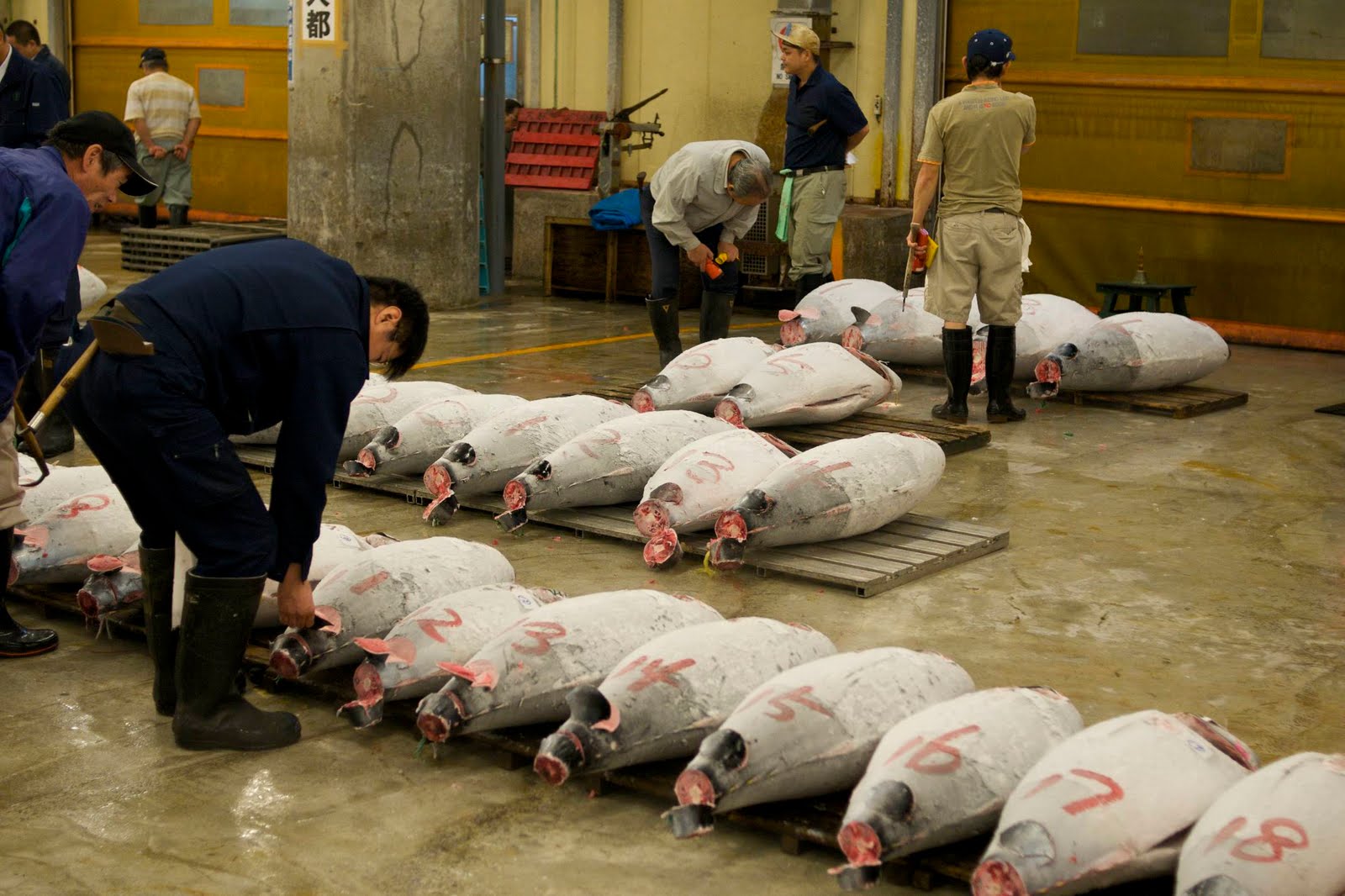
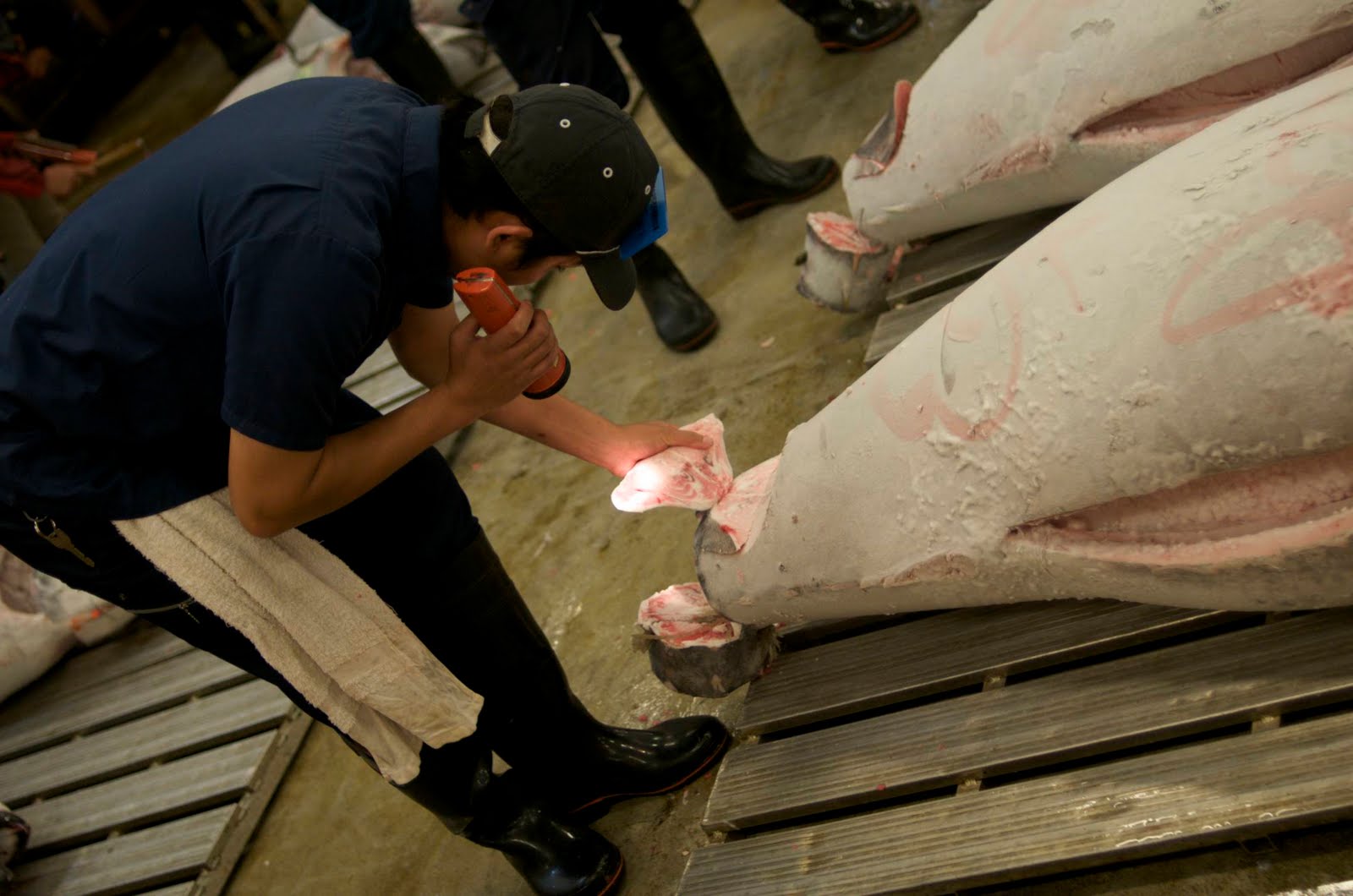
No need to worry - the tuna auction itself is pretty crazy, but despite the menacing looking hooks being wielded, no-one gets hurt. The tuna are all frozen and glistening white, their tails already hacked off and an incision made enabling the buyers to inspect the quality of the meat. There is much milling around and perusal of fish; careful scrutiny of the flesh, prodding with hooks and silent consideration. Everyone knows everyone else; they chat and joke, but keep their opinions to themselves.


Eventually a bell is frantically sounded, the auctioneer climbs atop a small box and the business begins. I've been to plenty of bloodstock auctions in my time, and watched Bargain Hunt on TV, but what follows is slightly different. The quiet looking auctioneer shouts faster than the drill sergeant in Full Metal Jacket. I'm watching for bidders, but they are almost impossible to detect; only a quick scribble after the fact betrays the purchase. Another guy paints a name on the fish itself, which is then hooked and hurriedly removed. As the auction progresses across the room, more guys come on with barrows and trolleys and set about removing the tuna to be sawn into manageable chunks.


The whole thing is over in a flash, and we are rudely bundled out of the room, stripped of our orange vests and left to fend for ourselves, in daylight, mercifully, in the insane world outside the door. The market men have swapped the bikes they rode in on for little motorised carts that whizz in and out of one another. There are millions of them; how they don't crash into one another, and everyone else, is a mystery. Huge mountains of polystyrene boxes line the road. Everyone is doing something.


It's just gone 6am, which means time for breakfast. I pull up a chair at Sushibun, that's been here for 160 years. The sushi is excellent, of course, hand pressed in front of you, but the miso soup with tiny clams is out of this world. Which is a relief, because it is obscenely expensive.

Visitors aren't supposed to enter the main market until after 9am, but I'm not about to wait around for two hours when I'm this tired. And besides, I have already decided that I don't feel comfortable wandering around taking photographs, so am going to keep the lens cap on. Instead, I'm going to do something that should make for a far better experience all round: I'm going shopping.

Once people realise you are actually going to buy something and have overcome the shock, they're very friendly. The prices are very reasonable compared to the outside, and the seafood unbeatably fresh. An afternoon in the kitchen later and the day ends with a meal of tuna sashimi, scallops in mirin on sake soaked edamame beans, calamaretti with shiso oil, marinaded salmon with sansho pepper and Japanese potato salad. All of which makes waking up at 3.30am seem almost worthwhile, though I'd rather not do it every day...

A walk in the park

It doesn't matter where you go in the world, Sunday afternoons are always best spent down the park.

The first thing we see on our way into Yoyogi park in Tokyo is some kind of rockabilly dance off. The natural gaiety of this hilarious scene is tempered slightly by the suspicious looking yakuzu tattoos, and the bottles of Jack Daniels they're chugging down, but it's still pretty funny. They must be sweating their nuts off.


Things become a little more civilised further into the park. There are people everywhere. Some guys blow giant bubbles, and we sit for a while watching the sheer joy on the faces of the children as they chase and burst their beautiful shapes.


In between these two extremes comes everything else; lovers relax in the shade, families play simple games. Pretty much everyone seems to be drinking. People are playing baseball, badminton, frisbee. Huge groups rehearse dance routines, chant, or do strange martial art drills. Everyone is enjoying themselves openly, unashamedly and in their own distinct ways. It's the human side of the big, busy city.

It doesn't feel so different to London. Pop down Victoria Park on a summer Sunday and it's a similar thing. Well, almost. You probably won't see too many of the local hardnuts throwing shapes at the entrance to London Fields, and somehow that slightly priggish, reserved Englishness will manage to shine through alongside the occasional ray of sun. But it's still Sunday, and the easy air of gentle relaxation, sympathetically imbued with a slow but steady stream of alcohol does just enough to anaesthetise any thoughts of Monday morning.


Tuesday, 21 September 2010

Miyajima

The best part of a tedious hour on the streetcar, ten minutes on a creaky old ferry, and the energetic throng of downtown Hiroshima is swapped for the languid streets of Miyajima.

Islands always feel so much further from the mainland than they actually are. An hour on the tram just gets you to a different part of town; those ten minutes bobbing across the water carry you to another world. Feral deer greet you from the ferry terminal just to prove the point.


The main attraction of Miyajima is the Itsukushima Shrine, a sprawling temple that floats on the water's edge. You can climb up the steps to a five storey pagoda, or tread the boardwalks as they hug the contours of the cove.


The shrine's big drawcard is its torii, or gate, that sits out at sea. It is one of the classic Three Views of Japan as first identified by Hayashi Razan in the seventeenth century. Accordingly, every man and his camera is here to capture the sight.

I arrogantly eschew everyone else's vantage point and go for a walk round the cove to scope the best angle. The sun is on its way down, and when it's not shining on the torii you don't get the benefit of its amazing colours. Everyone else is looking at the shady side.


I try and lure a deer into the foreground of a shot from the sand, but without any food to bribe him, it's difficult. He just looks at me contemptuously and seemingly threatens me with a snarly glare for taking his picture.


I'm looking across at the assembled masses with their tripods wondering why the hell they're bothering when it dawns on me (or should that be dusks?) that the sun is now setting behind me and they are snapping marvellous shots of it with the torii in the foreground. By the time I make it round there it's too late, but it was a crap sunset anyway and I'm pretty sure it wouldn't have been worth it. Everyone settles down to wait for the lights to come on. Sitting patiently for the last throes of daylight to extinguish themselves doesn't appeal too much, so I fortify myself with a good feed and return an hour later when it is pitch black, the lights are on, and everyone else has gone home.


Saturday, 18 September 2010

Hiroshima

Without warning, one fine Monday morning sixty-five years ago, the lives of the people of Hiroshima either ended suddenly or were changed, like the world, for ever.

Before dawn on August 6th 1945, three B29s took off from the island of Tinian bound for Hiroshima. The first of them was the Enola Gay; its cargo the three metre long A-Bomb known as Little Boy. It was dropped at 8.15am, and detonated 600 metres above the city centre. Everything within a two kilometre radius was instantly destroyed, and 70,000 people lost their lives. Those that didn't die in the blast suffered horrific radiation burns; many threw themselves into the river and drowned.


Yoshito Matsushige, a photographer, tried to document events in the hours that followed:

I fought with myself for thirty minutes before I could take the first picture. After taking the first, I grew strangely calm and wanted to get closer. I took about ten steps forward and tried to snap another; but the scenes I saw were so gruesome my viewfinder clouded with tears

In the aftermath it was impossible to tell who had lived or died. Ledgers detailed deaths and injuries; survivors scribbled notes around the city hoping that lost loved ones would see them and know they had survived. By the end of 1945 the death toll was around 140,000, and it grew over the years that followed as a result of the radiation. Over 225,000 people living in Japan today are hibakusha - survivors. One cannot even begin to imagine the scars they carry, inside and out.


There is little the Peace Memorial Museum can do to obscure the terrifying reality of what actually happened that day. The imagery is brutal and deeply disturbing: Pictures of burned bodies; a rusty tricycle that was buried in the yard along with its two year old owner; charred clothes; a melted child's lunch box. The testimony of survivors, and descriptions of the aftereffects; keloid scars, cataracts, tumours, leukaemia, in-utero deformities. Haunting drawings of the hibakusha line the walls.


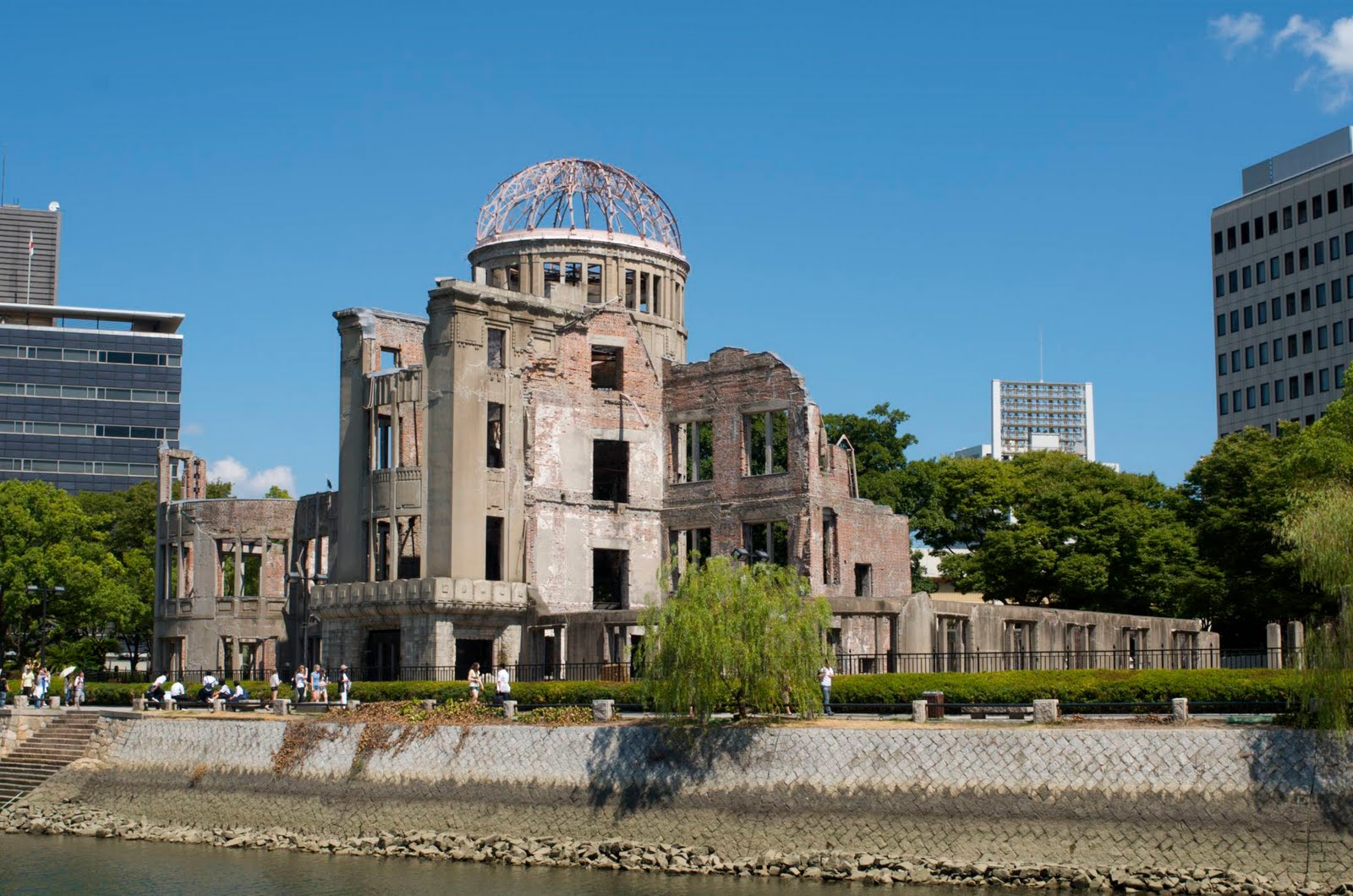
One building was so close to the hypocentre that the downward force of the explosion meant its infrastructure, unlike all the people inside it, survived. Its eerie skeleton and the dome that once shimmered on its shoulders stood defiantly in the midst of the ruined town.


In 1966 it was decided that the A-Bomb Dome, as it had come to be known, would remain in perpetuity as a monument to those who died and a lasting call to peace. Today it nestles in the heart of a vibrant, proud and modern city.


The wish that emerged from the suffering was not revenge or recompense; simply that no city should ever suffer the same fate. There is no greater measure of the courage and dignity of a race of people, and those who survived, than this. A flame burns in Peace Memorial Park, and will only be extinguished when the last nuclear weapon on Earth has been decommissioned.

Hiroshima testifies to the indomitability of the human spirit; in both the shadow of insurmountable horror, and the striving for peace. Razed to the ground, its inhabitants dead, brutally injured, traumatised, orphaned and poisoned, the city rebuilt itself. Human beings are capable of anything. Plunged into the darkest depths, they can climb out, and emerge even more determined to make the world a better place.


Many of the scientists who had worked on the Manhattan Project objected to the A-Bomb being deployed without prior warning. That it was used at all owed as much to considerations of the post-war world as anything else; Japan was already in disarray. Political and military expediency triumphed over morality, and a story that began over the White Sands of New Mexico reached across the Pacific and turned a different colour.

Shortly after the bomb was detonated, in the northwest of the city and beyond, it began to rain. People's roofs, shaken by the blast, were leaking, and the water streaked down their walls. The rain was black; the stains it left will never wash away.